
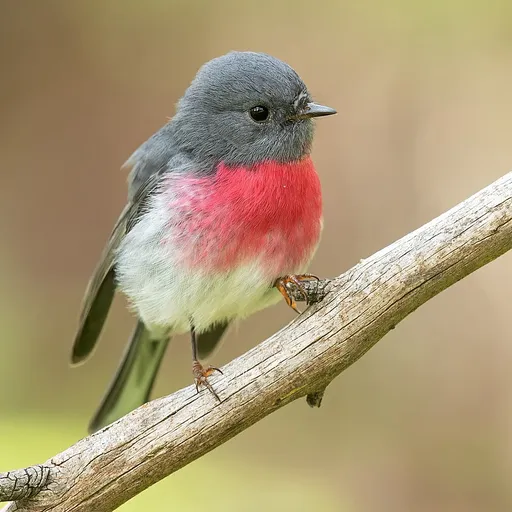
Rose Robin
Petroica rosea
Least Concern
Overview
The rose robin (Petroica rosea) is a small passerine bird native to Australia that exhibits distinct sexual dimorphism. Classified as Least Concern on the IUCN Red List, this species is part of the genus Petroica, whose members are colloquially known as 'red robins'.
Identification
- Male plumage features a distinctive pink breast and abdomen, dark grey upperparts with a white frons, and a black tail with white tips.
- Female plumage is undistinguished pale grey-brown above and grey-white beneath, with small white marks on the wings and over the bill.
- Both sexes possess a small black bill, legs, and eyes, with adult length measuring approximately 11 cm.
- Vocalisation consists of a tick call made by both males and females.
Habitat
Endemic to eastern and southeastern Australia east of the Great Dividing Range, from Queensland to southeastern South Australia, the rose robin is absent from Tasmania. It inhabits gullies and valleys within wet sclerophyll forest and rainforest, dispersing to drier forests in cooler months.
Diet
The diet consists primarily of insects and spiders, including caterpillars, wasps, beetles, flies, and ants, which are typically caught while flying. Found in ones or twos, these birds tend to feed in the tops of trees and do not return to the same branch while foraging.
Did you know?
The specific epithet rosea is derived from the Latin roseus meaning 'pink'. Its nests are constructed at significant heights of 10–20 m above the ground, bound with spider webs and lined with lichen on the exterior.
Sources
- Wikipedia · CC BY-SA 4.0
- Wikidata · CC0 1.0