
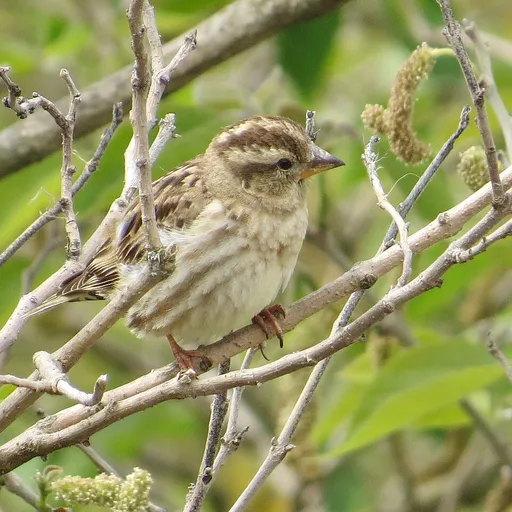
Rock Sparrow
Petronia petronia
Least Concern
Listen
XC803929 · Carlo Fracasso · Toro, Provincia di Campobasso, Molise, Italy · CC0 1.0
Overview
The rock sparrow (Petronia petronia) is a small passerine bird in the sparrow family Passeridae and the sole species in the genus Petronia. It is listed as Least Concern on the IUCN Red List. This species is resident in the western parts of its range, while some Asian populations migrate south or to lower altitudes in winter.
Identification
- Measures 15–17 cm in length, slightly larger than a house sparrow with a conspicuously larger, more conical bill.
- Features a strong whitish supercilium, a patterned brown back and wings, and streaked underparts.
- Displays a diagnostic, though hard-to-see, yellow throat spot or upper breast patch that contrasts starkly with earth-toned plumage.
- Produces a loud wheezy song.
Habitat
Breeds on barren rocky hills across a range extending from Madeira and the Canary Islands east through the Iberian Peninsula, western North Africa, and southern Europe, reaching southwest and central Asia, Mongolia, and parts of China. It is also found in human settlements in suitable country and is a very rare vagrant north of its breeding range.
Diet
Mainly forages on the ground, eating seeds throughout the year and berries in autumn. During spring, its diet includes invertebrates such as caterpillars and grasshoppers, which are also fed to the young.
Did you know?
Both sexes possess a carotenoid-based yellow breast patch that plays a crucial role during the breeding season by signalling attractiveness and social status. Males adjust their parental investment according to the size of their female partner's ornamentation, a behaviour not observed in females.
Sources
- Wikipedia · CC BY-SA 4.0
- Wikidata · CC0 1.0