
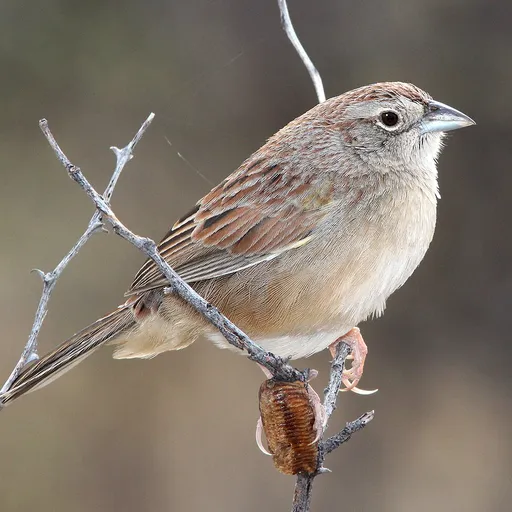
Botteri's Sparrow
Peucaea botterii
Least Concern
Listen
XC675426 · Diana Doyle · 3Canyons Ranch, United States · CC BY-SA 4.0
Overview
Botteri's sparrow (Peucaea botterii) is a species of bird in the family Passerellidae, the New World sparrows. It is found from the southwestern United States to Costa Rica and is currently assessed as being of Least Concern by the IUCN.
Identification
- Size approximately 15 to 17 cm in length, weighing 17 to 26 g, with sexually monomorphic plumage.
- Adults display a reddish brown crown, pale lores and supercilium, and a rusty streak behind the eye on a gray face.
- Upperparts are reddish brown with thin black streaks and gray feather edges, while the underparts feature a rusty chin and throat, grayish buff breast, and buffy flanks.
- Bill has a dusky maxilla and bluish mandible, with pinkish legs and feet and a brown iris.
- Males sing a complex, repetitive pattern, often described as up to seven short notes followed by a trill of increasing tempo.
Habitat
The species has a disjunct distribution, with northern subspecies inhabiting temperate and desert grasslands, savanna, oak woodlands, and coastal prairie from sea level to 2,000 m. Southern subspecies occupy similar landscapes as well as pine forest and lowland pine savanna, ranging from sea level to 1,500 m in northern Central America and between 500 and 1,100 m in Costa Rica. Juveniles require dense vegetation, such as the native sacaton grass or introduced lovegrass, for protection during fledging.
Diet
Botteri's sparrow feeds primarily on insects and seeds, foraging mostly on the ground. During the breeding season, it forages alone, in pairs, or in family groups, while larger flocks may congregate before fall migration.
Did you know?
Botteri's sparrow was absent from Arizona between the 1890s and the mid-20th century due to excessive livestock grazing, but has since recovered to become locally common in its range as vegetation has regenerated.
Sources
- Wikipedia · CC BY-SA 4.0
- Wikidata · CC0 1.0