
Olive Warbler
Peucedramus taeniatus
Least Concern
Overview
The olive warbler (Peucedramus taeniatus) is a small passerine bird that is the sole member of the family Peucedramidae, making it the only bird family endemic to North America. It was formerly classified with New World warblers but is now recognised as an early branch of the finch clade, having split before the differentiation of the broader New World warbler and sparrow groups.
Identification
- Medium-sized, long-winged bird measuring 13 to 14 cm in length.
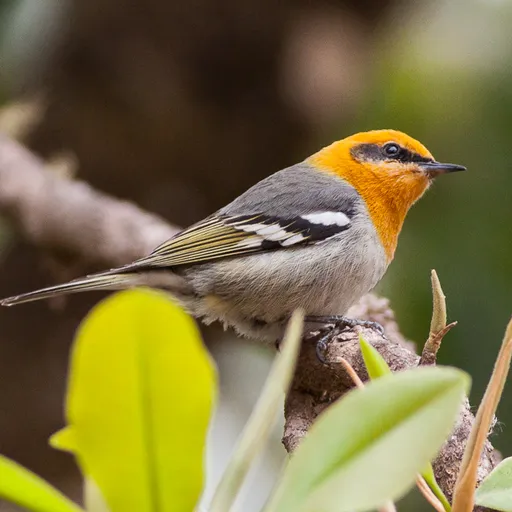
- Male plumage features a grey body with olive-green wings, two white wing bars, a tawny-orange head and breast, and a distinct black patch through the eye.
- Females and juveniles display similar markings but with yellow replacing the orange, and a more diffuse black mask.
- Song consists of clear whistles, such as 'hirrJI hirrJI hirrJI' and 'plida plida plida chir chir', typically delivered from the canopy or tall trees.
Habitat
Found in mountainous and highland regions from southern Arizona and New Mexico through Mexico to Nicaragua, the species primarily inhabits coniferous forests such as ponderosa, sugar pine, and Abies common fir, as well as oak and pine forests. Elevation varies across its range, from as low as 1,000 m in Honduras to over 3,500 m in parts of its northern distribution, often in forests ranging from humid to semi-arid conditions.
Diet
As an insectivore, it feeds on insects and other arthropods, including the larvae of Tortricidae moths. Foraging takes place in the canopy and subcanopy layers, specifically within the outer branches and twigs of trees such as ponderosa pines, grey oaks, and silverleaf oaks.
Did you know?
The genus name Peucedramus derives from the Greek words for a fir tree and 'runner', a reference to the bird's feeding habitat and its characteristic running behaviour within those trees.
Sources
- Wikipedia · CC BY-SA 4.0
- Wikidata · CC0 1.0