
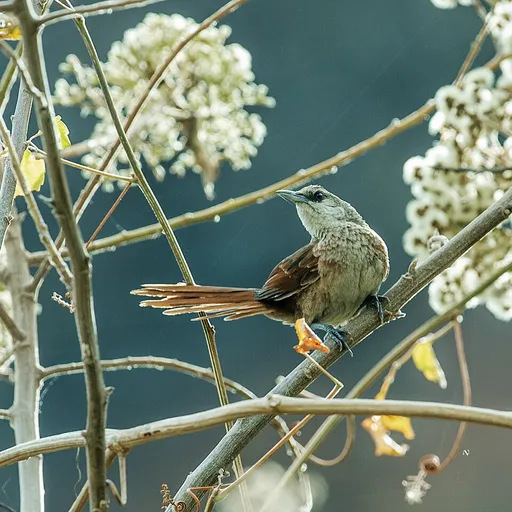
Chestnut-backed Thornbird
Phacellodomus dorsalis
Near Threatened
Overview
The chestnut-backed thornbird (Phacellodomus dorsalis) is a Near Threatened species of ovenbird endemic to Peru. It belongs to the family Furnariidae and is recognised as the longest and most heavy-billed member of its genus.
Identification
- A medium-sized bird measuring 19 to 21 cm in length, which is the longest in its genus.
- Plumage features a light grey-brown supercilium, a thin dark mask, and a greyish-brown upper back that transitions to a chestnut lower back; the underparts include a white throat, a tawny brownish upper breast with whitish spots, and a mottled whitish and brownish belly.
- Bill is notably the longest in the genus, with a dark olive-horn to dark horn maxilla and a silver-grey to olive-grey mandible.
- Song consists of a series of ticking 'chit-chit-chit' notes that may accelerate into a loud 'chup-chup-chup' phrase.
Habitat
This species is restricted to a few locations in the upper Marañón River valley in Peru. It inhabits arid montane scrublands, typically those containing short Prosopis or Acacia macracantha trees, at elevations between 1,800 and 3,100 m, though occasionally up to 3,400 m.
Diet
The specific diet has not been thoroughly studied but appears to consist of arthropods. Foraging usually takes place singly or in pairs, with the bird gleaning prey from branches and foliage up to about 4 m above the ground.
Did you know?
Despite being classified as Near Threatened, the species does not occur in any protected areas, making the creation of a reserve a high priority for its conservation. It was previously assessed as Vulnerable in 2000 before being reclassified in 2020.
Sources
- Wikipedia · CC BY-SA 4.0
- Wikidata · CC0 1.0