
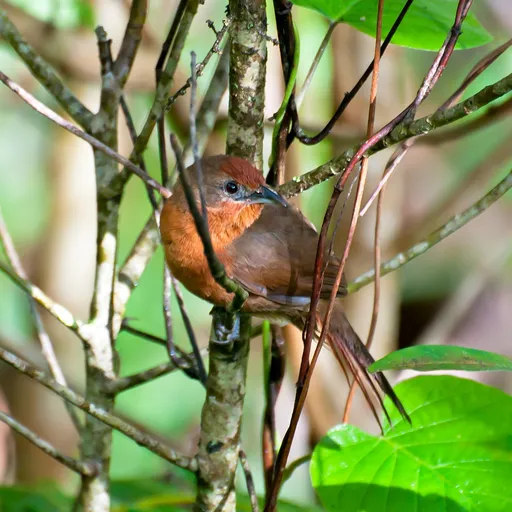
Orange-breasted Thornbird
Phacellodomus ferrugineigula
Least Concern
Overview
The orange-breasted thornbird (Phacellodomus ferrugineigula) is a medium-sized bird in the ovenbird family Furnariidae. It is currently assessed as a species of Least Concern and is a year-round resident throughout its range.
Identification
- Length of 17 to 18 cm with a bright rufous forehead and crown, contrasting with a dark brownish olive back.
- Orange-rufous throat and breast, a whitish belly, and a red iris.
- Song consists of loud ringing notes, often sung in duet by a pair, described as 'ku, keeé-keeé-keeé-keeé-keeé-kuh'.
Habitat
Found in southeastern Brazil, Uruguay, and possibly Argentina, it inhabits thickets in freshwater marshes, gallery forests, and dense secondary forests. Elevations mostly range from sea level to 750 m, though it reaches higher altitudes in specific Brazilian states.
Diet
Its diet has not been formally studied but is believed to consist mostly of arthropods. The bird typically forages singly or in pairs, gleaning prey from the vegetation within the forest's thick undergrowth.
Did you know?
It weaves the leaves and stems of grasses into a tight, tube-entranced nest that differs from those of other thornbirds. This structure is typically suspended from the tip of a branch up to 1.6 m above the ground or water.
Sources
- Wikipedia · CC BY-SA 4.0
- Wikidata · CC0 1.0