
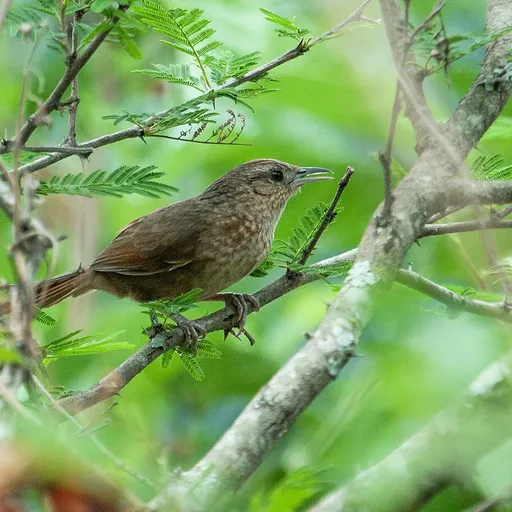
Spot-breasted Thornbird
Phacellodomus maculipectus
Least Concern
Listen
XC757725 · Belén y Diego · Valle Colorado, Valle Grande, Jujuy, Argentina · CC0 1.0
Overview
The spot-breasted thornbird (Phacellodomus maculipectus) is a medium-sized bird in the ovenbird family Furnariidae, found in parts of Bolivia and Argentina. It was historically considered a subspecies of the freckle-breasted thornbird but is now recognised as a distinct species, with the greater thornbird as its sister species.
Identification
- Size: 17–18 cm (6.7–7.1 in) long, weighing 19–26 g.
- Plumage: Light brownish face with a rufous-brown, whitish-streaked crown and dull reddish-brown back. A dingy whitish throat, and a dark brownish breast with conspicuous white speckles. Belly brownish white, with grey-brown flanks.
- Bill and legs: Blackish to brownish upper bill, grey lower bill, and grey to greenish-grey legs.
- Song: A sequence of 10–25 evenly spaced, complaining 'kew' or 'kééé-keee' notes. Alarm call is a series of squeaky ticking notes.
Habitat
The species inhabits dry to somewhat humid montane woodland and scrubland in Bolivia (Cochabamba and Santa Cruz) and northern Argentina (down to La Rioja). Its elevational range is mostly 1,000–2,500 m, though it can locally reach 3,100 m.
Diet
It feeds on adult and larval arthropods, usually in pairs. It forages by gleaning from the ground and from vegetation up to the forest understorey.
Did you know?
The bird breeds in the austral spring and summer, beginning in September, building a cylindrical nest of thorny sticks up to 30 cm high, lined with grass, and hung near the end of a tree branch 3–4 m above the ground.
Sources
- Wikipedia · CC BY-SA 4.0
- Wikidata · CC0 1.0