
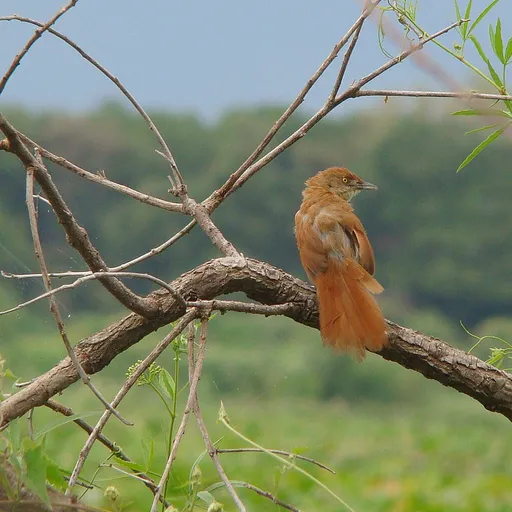
Greater Thornbird
Phacellodomus ruber
Least Concern
Listen
XC675965 · Graznidos y gorjeos · Reserva Ribera Norte, Acassusso, San Isidro, Buenos Aires, Argentina · CC0 1.0
Overview
The greater thornbird (Phacellodomus ruber) is a species of ovenbird found across parts of South America. It is the heaviest and reddest of the thornbird species and is classified as Least Concern on the IUCN Red List.
Identification
- Size and Plumage: Measuring 19 to 21 cm in length, it is the heaviest thornbird, featuring rich reddish brown to olive-brown back and wings, with a reddish chestnut crown streaked with pale marks.
- Head and Face: Adults possess a rufescent brown to grayish brown face with a paler supercilium and ear coverts, a whitish malar area, and a whitish throat.
- Vocalisation: The song consists of up to 20 loud, sharp, and resounding notes that start high and explosive before gradually descending, often performed in duet by pairs.
- Juvenile Markings: Younger birds have a less defined crown patch than adults and exhibit brownish mottling on their breast.
Habitat
Found in north-central and eastern Bolivia, eastern Brazil, central Paraguay, northern Argentina, and western Uruguay, the species inhabits a variety of landscapes that are almost always near water. Preferred environments include thickets along watercourses, gallery forest, marsh borders, and scrublands, typically between 300 and 1,100 m in elevation.
Diet
The greater thornbird feeds on a wide variety of arthropods, usually foraging in pairs. It captures prey by gleaning from the ground or vegetation, such as in the forest understorey.
Did you know?
This species constructs a cone-shaped nest from thorny twigs and branches that can stand 60 cm high, which it hangs from a tree branch usually over water.
Sources
- Wikipedia · CC BY-SA 4.0
- Wikidata · CC0 1.0