
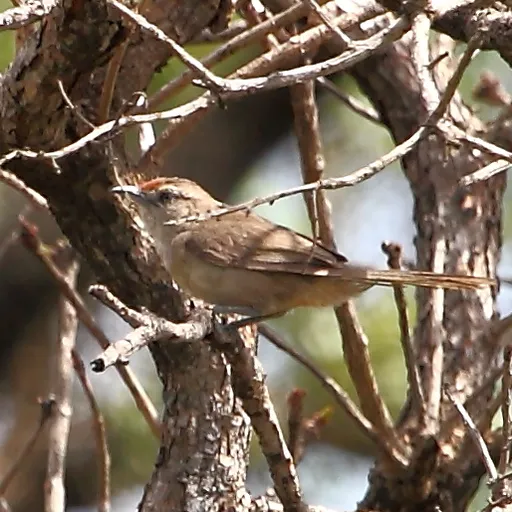
Rufous-fronted Thornbird
Phacellodomus rufifrons
Least Concern
Listen
XC250430 · Niels Krabbe · Zamora-Chinchipe: SE Zumba: turnoff to Chito on La Chonta - El Chorro road, Ecuador · CC BY-SA 4.0
Overview
The rufous-fronted thornbird, also known as the common thornbird (Phacellodomus rufifrons), is a species in the family Furnariidae. It is classified as Least Concern by the IUCN, with a very large but disjunct range and a stable population.
Identification
- 16 to 17 cm long, weighing 18 to 31 g, with identical plumage in both sexes.
- Forehead is dark rufous and the crown is dark brownish with paler streaks; upperparts are slightly lighter dark brown.
- Underparts are brownish white with darker brownish sides and flanks; undertail coverts have a rufescent tinge.
- Song is a rather unstructured series of very high, mewing 'stjew' notes that rise, fall, and repeat.
- Calls include an extremely high, sharp 'sipsipsip-sip-', or a sharp 'chip'/'chek', or a metallic 'tsi'.
Habitat
Found across Brazil, Bolivia, Argentina, Ecuador, Paraguay, and Peru, with a disjunct distribution. It inhabits diverse landscapes featuring dense thickets and trees, including arid scrublands, tropical forests, cerrado, and savannah. Elevation ranges from below 1,300 m in Brazil to locally as high as 2,000 m elsewhere.
Diet
Feeds on arthropods, usually foraging in pairs or small groups that include nest helpers, though rarely joining mixed-species flocks. Primarily glean prey from leaf litter on the ground, but may search dead foliage in bushes up to the forest's mid-level.
Did you know?
It constructs an extremely large nest for its size, forming a cylinder of thorny sticks that can reach 2.5 m (8 ft) in length and containing several chambers and entrances. Young from previous broods often remain to assist with nest building, maintenance, and defence.
Sources
- Wikipedia · CC BY-SA 4.0
- Wikidata · CC0 1.0