
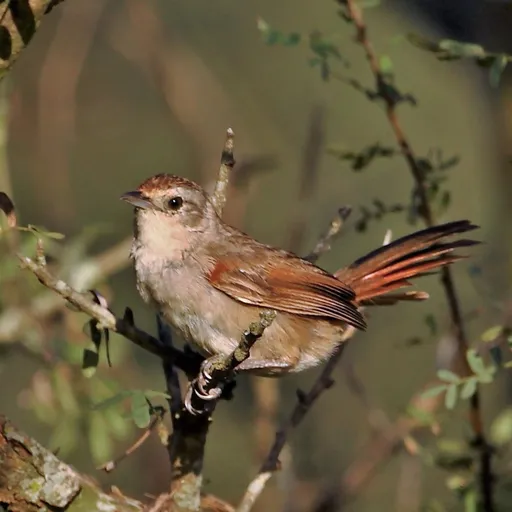
Little Thornbird
Phacellodomus sibilatrix
Least Concern
Listen
XC633280 · Capovilla Pablo H · Capivara, San Cristóbal, Santa Fe, Argentina · CC BY-SA 4.0
Overview
The little thornbird (Phacellodomus sibilatrix) is a species of bird in the ovenbird family Furnariidae, specifically within the Furnariinae subfamily. It is the smallest member of its genus and is found across parts of South America.
Identification
- Size: 13 to 14 cm long, weighing approximately 14 to 16 g.
- Plumage: Adults feature a wide dull buff-whitish supercilium extending beyond the eye, light rufous forehead with pale streaks, and dull brown crown and back; underparts are dingy whitish with tawny-brown flanks.
- Bill and Legs: Maxilla is black to dark gray, mandible light horn-gray to gray, with legs and feet ranging from gray to pinkish gray.
- Vocalisation: The song is a duetted series of sharp, piercing, loud 'tee tee tees' where one bird sings faster than the other, producing a 'tee teeter' effect; calls consist of a sharp, often repeated 'chip'.
Habitat
Found in Argentina, Bolivia, Brazil, Paraguay, and Uruguay, this bird inhabits tropical deciduous forests, Gran Chaco woodlands, savannah with scattered trees, and scrublands. It resides at elevations from near sea level up to 2,000 m.
Diet
The little thornbird feeds on arthropods, usually foraging in pairs or small groups that may include nest helpers, and occasionally joins mixed-species feeding flocks. It captures prey by gleaning from the ground or from vegetation as high as the forest's mid-storey.
Did you know?
The bird constructs cone-shaped nests made of thorny sticks that can reach about 40 cm in height, lining the interior with shredded vegetation, hair, and feathers. These nests are typically hung near the end of a bush or tree branch, usually in an isolated tree or small cluster.
Sources
- Wikipedia · CC BY-SA 4.0
- Wikidata · CC0 1.0