
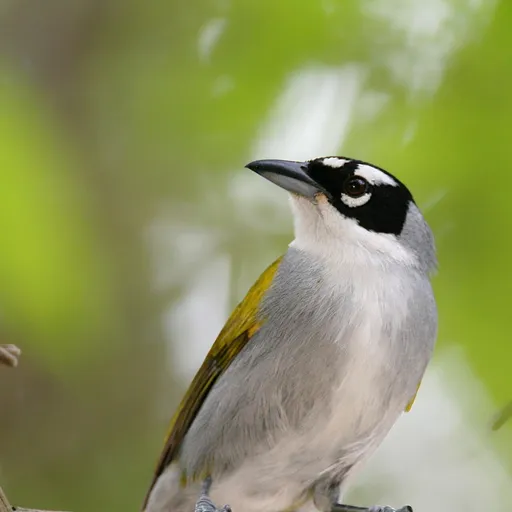
Black-crowned Palm-tanager
Phaenicophilus palmarum
Least Concern
Overview
The black-crowned palm-tanager (Phaenicophilus palmarum) is a bird species in the family Phaenicophilidae, endemic to the island of Hispaniola. It is classified as a species of Least Concern by the IUCN due to its large range and stable population.
Identification
- Measures 17 to 18 cm in length and weighs between 24 and 32 g, with little sexual dimorphism.
- Features a long, strong, sharply pointed bill with a black upper mandible and a blue-gray lower mandible tipped in black.
- Adults display a mostly black head with distinctive white patches above the bill and eye, a gray nape, and bright yellowish olive upperparts.
- Song consists of jumbled squeaky notes that increase in volume before slowing into short 'chit' notes, often accompanied by a nasal, buzzy 'pe-u' call.
Habitat
Found throughout the mainland Dominican Republic and most of Haiti, this species inhabits a wide variety of landscapes ranging from dry to humid and open to dense forests. It also thrives in rural and urban gardens and parks, typically ranging from sea level to about 2,500 m in elevation.
Diet
The black-crowned palm-tanager forages in pairs or family groups at all levels of the forest and occasionally joins mixed-species flocks. Its diet comprises approximately two-thirds insects and one-third fruit, supplemented by a small amount of nectar.
Did you know?
This species has successfully adapted to human-altered environments, often constructing its deep cup nests in trees or bushes near human habitations.
Sources
- Wikipedia · CC BY-SA 4.0
- Wikidata · CC0 1.0