
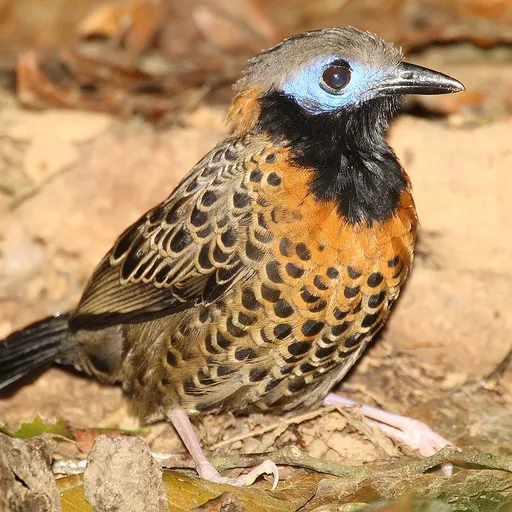
Ocellated Antbird
Phaenostictus mcleannani
Least Concern
Listen
XC759709 · radrat · Pipeline Road, Colón, Colón Province, Panama · CC0 1.0
Overview
The ocellated antbird, Phaenostictus mcleannani, is a species of typical antbird found in Central and northern South America. It is the only member of its genus and is classified as Least Concern by the IUCN despite a declining population trend.
Identification
- A largish antbird measuring 17.5 to 20 cm in length with a long bill and tail.
- Adults feature a brown-gray crown, rufous-brown nape, and bright blue bare skin around the eye, contrasting with black cheeks and throat.
- Back feathers and wing coverts are black with narrow rufous-brown edges, creating a scaly appearance, while the breast is plain rufous-brown and the belly is black with wider rufous-brown edges.
- The primary song is a loud, high-thin series of whistles that rises then falls, with the latter notes gaining in harsh quality, transcribed as "peee-peee-pee-peepee-ee-ee-ee-ee-ee-ee-ee-eer-eer".
Habitat
This species ranges from Honduras to Ecuador, inhabiting lowland and foothill evergreen forests where it favours old-growth primary forest but also occurs in mature secondary forest. It almost entirely remains in the forest undergrowth, reaching elevations of up to 1,250 m in Central America, 900 m in Colombia, and locally 700 m in Ecuador.
Diet
An obligate ant follower, it feeds on arthropods that flee foraging army ant swarms such as Eciton burchellii. It typically forages in pairs or family groups perching within about 1 m of the ground, often near the front of the ant swarm, and sallying after prey.
Did you know?
The genus name Phaenostictus is derived from Ancient Greek meaning "to display" and "spotted", while the specific epithet honours James McLeannan, a railway engineer on the Panama Canal Railway who collected the type specimen.
Sources
- Wikipedia · CC BY-SA 4.0
- Wikidata · CC0 1.0