
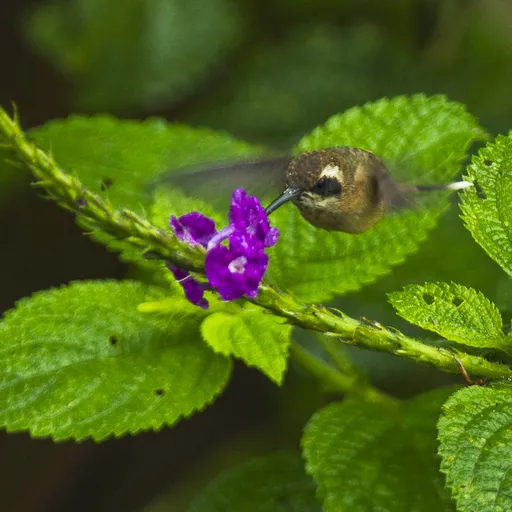
Grey-chinned Hermit
Phaethornis griseogularis
Least Concern
Listen
XC251323 · Niels Krabbe · Zamora-Chinchipe: Filo de Chumbiriatza, tepui 4.5 km SW Las Orchideas, above "Cabañas Yankuam", Nangaritza Valley, Ecuador · CC BY-SA 4.0
Overview
The grey-chinned hermit (Phaethornis griseogularis) is a species of hummingbird in the family Trochilidae native to the tepuis and northern Andes. It is assessed as a species of Least Concern by the IUCN, though its population is believed to be decreasing.
Identification
- Generally greenish upperparts with a cinnamon red rump and dark tail feathers featuring white tips.
- Males display a grayish throat and cinnamon red underparts, often with a black band across the chest; females are paler versions of the males.
- Males are 8 to 10 cm (3.1 to 3.9 in) long and weigh between 1.8 and 2.5 g (0.06 to 0.09 oz), while females are 1.9 to 3 g (0.07 to 0.11 oz).
- Vocalisations include a high-pitched, incessant series of notes described as 'tsi ... tsee ... tseeé ... tseotsetsee' and an explosive 'tseek!' call in flight.
Habitat
Native to the tepuis and northern Andes, the species ranges from the eastern Andes of Colombia through Ecuador and Peru, extending into parts of Venezuela and northern Brazil. It favours dense growth such as cloudforest understory, secondary forest, and forest edges, typically at elevations between 600 and 1,800 m (2,000 and 5,900 ft), though variations exist by subspecies.
Diet
The nominate and zonura subspecies are 'trap-line' feeders that visit circuits of flowering plants for nectar and also consume small arthropods. The porcullae subspecies is assumed to follow a similar feeding strategy and diet.
Did you know?
The only described nest belongs to the porcullae subspecies, consisting of a cup made of moss and seed down suspended from the underside of a long drooping leaf, and it contained two eggs that both hatched.
Sources
- Wikipedia · CC BY-SA 4.0
- Wikidata · CC0 1.0