
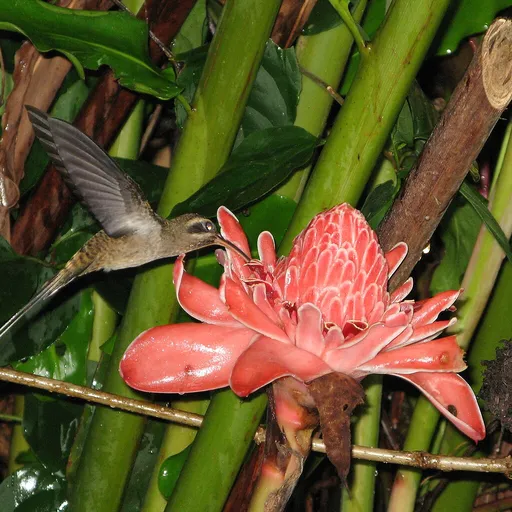
Long-billed Hermit
Phaethornis longirostris
Least Concern
Listen
XC519609 · Oliver Komar · Darién Province (On Boca de Cupe trail on way to Cana, inside Darien National Park), Panama · CC BY-SA 4.0
Overview
The long-billed hermit (Phaethornis longirostris) is a species of hummingbird found from central Mexico south through Central America, Colombia and Ecuador into Peru. It is generally classified as Least Concern by the IUCN, although population sizes and trends remain unknown.
Identification
- Size: 13 to 16 cm long, with males weighing 5–7.5 g and females 4–6.5 g.
- Plumage: Greenish-brown upperparts and brownish to grayish underparts in the nominate subspecies; some subspecies feature darker metallic green uppers or whiter bellies.
- Bill: Long and decurved, with males possessing a longer, dagger-like tip used as a secondary sexual trait.
- Song: Northern subspecies sing a continuous series of piercing, upslurred 'sweeup' notes, while P. l. baroni produces sparrow-like chipping notes.
Habitat
The species inhabits the understory and edges of diverse landscapes, including rainforest, tall secondary forest, humid semi-deciduous forest, cloudforest, and gallery forest. Its elevation range varies by region, extending from sea level up to 2,500 m in northern Colombia.
Diet
As a 'trap-line' feeder, the long-billed hermit visits a circuit of various flowering plants such as Heliconia, Costus, Aphelandra, and Passiflora for nectar. It also consumes small arthropods.
Did you know?
Mature males utilise the dagger-like tip of their long bill as a secondary sexual trait to defend against other males during competitive lek singing, which can occupy half of the daylight hours.
Sources
- Wikipedia · CC BY-SA 4.0
- Wikidata · CC0 1.0