
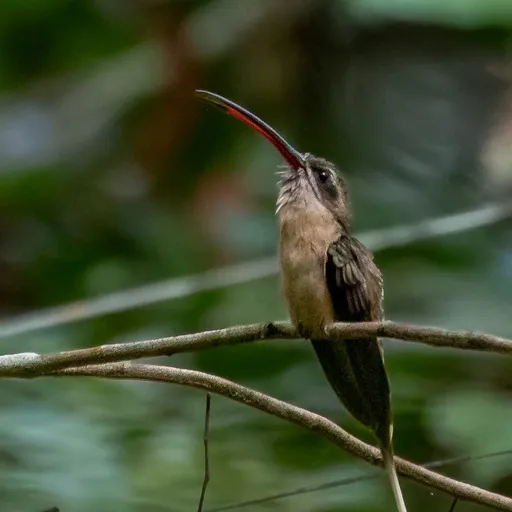
Great-billed Hermit
Phaethornis malaris
Least Concern
Overview
The great-billed hermit (Phaethornis malaris) is a species of hummingbird belonging to the family Trochilidae. It is distributed across parts of South America and is classified as Least Concern by the IUCN, although its population size is unknown and believed to be decreasing.
Identification
- Measures between 13 and 17.5 cm in length, with males weighing 4.5 to 10 g and females 4 to 8 g.
- Features greenish-brown upperparts and brownish to grayish underparts, with dark and light ochre bands on the uppertail coverts and long central tail feathers tipped in white.
- Possesses a long decurved bill, which is shorter but more curved in females than in males.
- Vocalises with a continuous series of single, bisyllabic rising and falling 'slee-up' notes, and may produce a sharp 'skweep!' call, usually in flight.
Habitat
Found in Bolivia, Brazil, Colombia, Ecuador, French Guiana, Peru, Suriname, and Venezuela. It inhabits the understory of various rainforest landscapes, including terra firme, foothill, and higher elevation tropical forest, as well as transitional forest, secondary forest, and bamboo thickets. Most populations occur below 600 m, though they reach 1,500 m in Colombia and 2,400 m in Bolivia.
Diet
The great-billed hermit acts as a trap-line feeder, visiting a circuit of various flowering plants such as Heliconia and Pitcairnia for nectar. It also consumes small arthropods.
Did you know?
Its breeding seasons vary significantly across its range, occurring from August to December in French Guiana, June to September in Bolivia, and June to November in Peru. The subspecies P. m. margarettae, restricted to forest remnants in eastern Brazil, could be threatened by further habitat destruction.
Sources
- Wikipedia · CC BY-SA 4.0
- Wikidata · CC0 1.0