
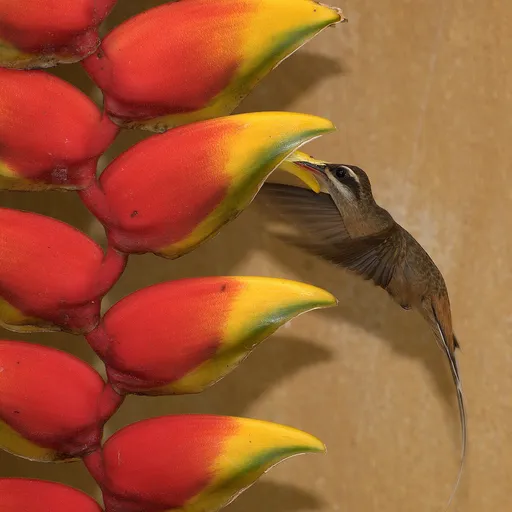
Planalto Hermit
Phaethornis pretrei
Least Concern
Overview
The planalto hermit (Phaethornis pretrei) is a species of hummingbird found across several South American countries. It is assessed as Least Concern on the IUCN Red List, reflecting its common presence throughout its large range. The bird is well adapted to human-modified environments, frequently appearing in gardens and city parks.
Identification
- Medium-sized hermit measuring 14 to 16.5 cm in length, with males weighing 4.5 to 7 g and females 3 to 5 g.
- Mostly olive green upperparts with reddish uppertail coverts and cinnamon-red underparts.
- Distinctive facial markings include a black 'mask' accompanied by a white supercilium and gular stripe.
- Tail feathers are longer than others and feature white tips; the song consists of variable sequences of alternating single and double notes, such as 'ti-tsi...tsi...tsi' or triple-noted phrases like 'chu-tsi-tsi'.
Habitat
The species inhabits a variety of landscapes, including dry forest, secondary forest, gallery forest, and non-forested but vegetation-rich areas. It is also found in human-modified environments where trees and herbs are present, ranging in elevation from 400 to 2,100 m. Its distribution covers a wide swath of Brazil south of the Amazon rainforest, eastern Bolivia, northern Argentina, much of Paraguay, and parts of Peru.
Diet
The planalto hermit acts as a 'trap-line' feeder, visiting a circuit of flowering plants to consume nectar. It also preys on small arthropods to supplement its diet.
Did you know?
Unlike most other Phaethornis hermits, the planalto hermit constructs long cone-shaped nests that it hangs from vertical branches, places in rock face cavities, or situates under human structures such as culverts, bridges, and abandoned buildings.
Sources
- Wikipedia · CC BY-SA 4.0
- Wikidata · CC0 1.0