
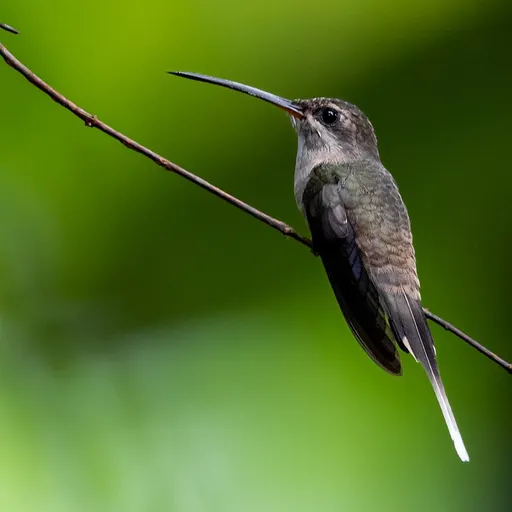
Long-tailed Hermit
Phaethornis superciliosus
Least Concern
Overview
The long-tailed hermit (Phaethornis superciliosus) is a large hummingbird that serves as a resident breeder in Venezuela, the Guianas, and north-eastern Brazil. It is the largest of the hermit hummingbirds, previously known as the eastern long-tailed hermit.
Identification
- Mains dull brownish-green plumage above with a buff-tinged rump and pale greyish-buff underparts.
- Features a distinct dark mask through the eye bordered by whitish-buff stripes.
- Possesses a very long, decurved bill with a red-tipped black lower mandible.
- Displays long central tail feathers that are white-tipped and can reach 6.3-6.8 cm in length.
Habitat
This species inhabits forest undergrowth, typically near water sources and its preferred food plants. Its range encompasses south Venezuela, the Guianas, and north-eastern Brazil, extending to both north and south of the Amazon.
Diet
The bird feeds on nectar from large flowers such as Heliconias, gingers, and passion flowers, supplementing its diet with small insects and spiders for protein. It employs trap-line foraging, visiting seasonal flowers along routes through the forest that can extend up to 1 km long without defending a territory.
Did you know?
During the breeding season, males gather in communal leks of up to several dozen birds to sing and wiggle their long tails, with this competitive display occupying half of the daylight hours to attract females.
Sources
- Wikipedia · CC BY-SA 4.0
- Wikidata · CC0 1.0