
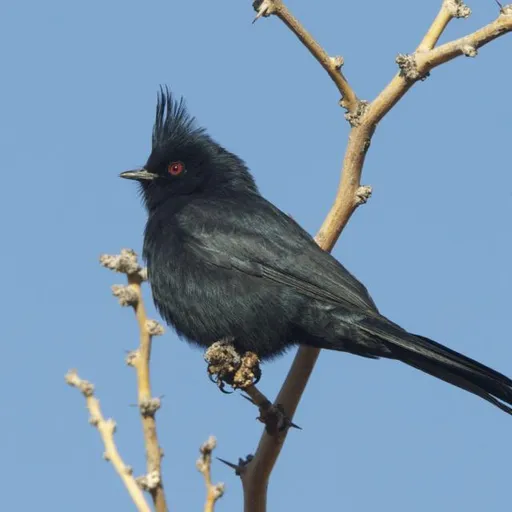
Phainopepla
Phainopepla nitens
Least Concern
Overview
The phainopepla is the most northerly representative of the mainly tropical Central American family Ptiliogonatidae. Its name derives from the Greek for "shining robe", referring to the glossy plumage of the male.
Identification
- Slender body with an upright posture, measuring 16–20 cm in length, featuring a noticeable crest and long tail.
- Short, slender bill and red eyes that are more noticeable in females than in males.
- Males are glossy black with a white wing patch visible in flight, while females are plain gray with a lighter gray wing patch.
- Imitates the calls of twelve other species, such as the red-tailed hawk and the northern flicker.
Habitat
This species ranges from central California and southern Utah in the north to central Mexico in the south, where the transverse mountains serve as its non-breeding home. It inhabits hot areas, including desert oases, and is commonly found in the deserts of Arizona, southern Nevada, and southern California.
Diet
The diet consists of berries, small insects, fruits, and vegetables. Phainopeplas possess a specialized gizzard mechanism that shucks berry skins, allowing for efficient digestion and the rapid processing of hundreds of berries per day.
Did you know?
Phainopeplas are closely associated with desert mistletoe, acting as its most effective seed disperser by depositing feces on tree branches to allow the seeds to sprout and infect the host.
Sources
- Wikipedia · CC BY-SA 4.0
- Wikidata · CC0 1.0