
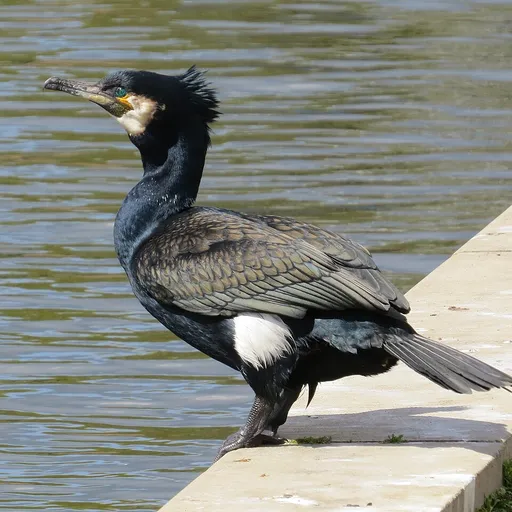
Great Cormorant
Phalacrocorax carbo
Least Concern
Listen
XC1107811 · Sonothèque ADVL · Arrondissement of Avranches (near Genêts), Manche, Normandy, France · CC0 1.0
Overview
The great cormorant (Phalacrocorax carbo) is a widespread seabird belonging to the cormorant family, known locally as the cormorant in Britain or black shag in New Zealand. It is one of the two largest extant cormorant species, characterised by its broad distribution across the Old World, Australasia, and parts of North America.
Identification
- Large and bulky bird with largely black plumage that displays bronze-green iridescence on the wings and tail, and a purple tinge on the body.
- Adults feature striking deep sea-green eyes, while juveniles have duller dark grey eyes and paler, whitish underparts.
- Possesses a stout, dark grey bill strongly hooked at the tip, often with a yellow or red patch of bare gular skin at the base.
- In the breeding season, adults display white filoplume patches on the head and upper neck, which are shed in winter.
Habitat
This species feeds in inshore waters, estuaries, and freshwater lakes and rivers, nesting in colonies on trees, cliff ledges, or predator-free rocky islands. It breeds across much of the Old World, Australasia, and the Atlantic coast of North America, with northern populations migrating south to unfrozen waters during winter.
Diet
The great cormorant feeds exclusively on fish, capturing prey through foot-propelled diving to depths of up to 9.5 metres. Foraging efficiency in winter increases by targeting larger, torpedo-shaped fish rather than increasing the total number of captures, with some freshwater populations consuming up to 80 kg of fish per hectare annually.
Did you know?
In cormorant fishing practices found in China and Japan, birds learn to refuse their eighth dive if the traditional reward of keeping every eighth fish is withheld. The cormorants also become so attuned to the fishermen's lines that they will not dive at all if the line is not untied first.
Sources
- Wikipedia · CC BY-SA 4.0
- Wikidata · CC0 1.0