
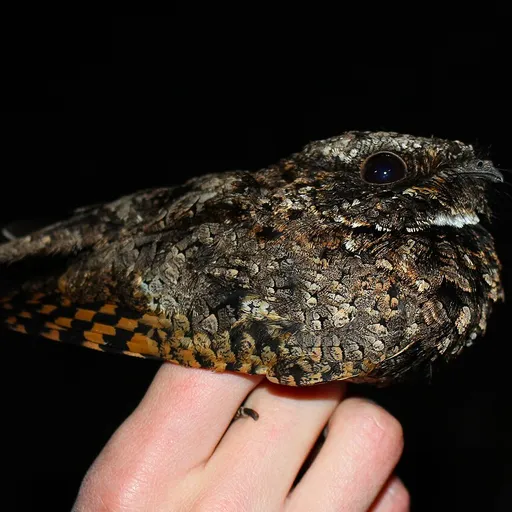
Common Poorwill
Phalaenoptilus nuttallii
Least Concern
Overview
The common poorwill (Phalaenoptilus nuttallii) is a nocturnal nightjar found across western North America. As a member of the family Caprimulgidae, it is the smallest nightjar in North America and is listed as Least Concern on the IUCN Red List.
Identification
- Small size, approximately 18 cm in length with a wingspan of about 30 cm.
- Grey and black patterned plumage with outer tail feathers tipped in white.
- Distinctive monotonous 'poor-will' call, sometimes with a third syllable ('poor-will-low'), heard from dusk to dawn.
- Short bill and rounded wings that reach the end of the short tail at rest.
Habitat
It occupies dry, open areas with grasses or shrubs, extending to stony desert slopes with minimal vegetation. Its range spans from British Columbia and southeastern Alberta through the western United States to northern Mexico.
Diet
This bird feeds on nocturnal insects such as moths, beetles, and grasshoppers, often taking prey off the ground or by leaping into the air. It ejects pellets of indigestible material, similar to owls, and has been reported to drink on the wing.
Did you know?
The common poorwill is the only bird known to enter torpor for extended periods of weeks to months. It was observed by Meriwether Lewis during the Lewis and Clark expedition in 1804, though its significance was not fully understood until the mid-20th century.
Sources
- Wikipedia · CC BY-SA 4.0
- Wikidata · CC0 1.0