
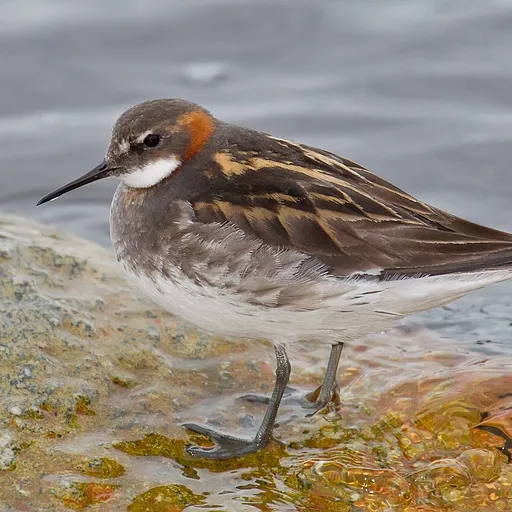
Red-necked Phalarope
Phalaropus lobatus
Least Concern
Listen
XC1157165 · Teet Sirotkin · Kvalnesvatnet, Vardø, Finnmark, Norway · CC BY-SA 4.0
Overview
The red-necked phalarope, also known as the northern or hyperborean phalarope, is a small migratory wader that breeds in the Arctic regions of North America and Eurasia. Unlike most waders, it spends its non-breeding season at sea on tropical oceans, making it a species of Least Concern on the IUCN Red List.
Identification
- Length of about 18 cm with a straight, fine bill and distinctive lobed toes that assist with swimming.
- Breeding females are predominantly dark grey above with a chestnut neck and upper breast, a black face, and a white throat, featuring a white wing stripe to distinguish them from Wilson's phalarope.
- Breeding males resemble females but are duller in colour, while winter plumage is grey above and white below, with a black eyepatch always present.
- Vocalisation consists of a sharp call described as a whit or twit.
Habitat
This species breeds in Arctic tundra areas of North America and Eurasia, nesting in grass-lined depressions on small mounds. It is migratory and winters in open tropical oceans, occasionally stoping over in coastal areas like the Bay of Fundy to exploit tidal upwellings.
Diet
Feeding involves swimming in small, rapid circles to create a whirlpool that raises food from the bottom of shallow water. The bird then reaches into the centre of the vortex to pluck small insects or crustaceans, often utilising converging currents or tidal action for food.
Did you know?
Females are larger than males and aggressively pursue and fight over them, defending their chosen mate until the clutch is complete, after which the male performs all incubation and chick-rearing duties.
Sources
- Wikipedia · CC BY-SA 4.0
- Wikidata · CC0 1.0