
Brush Bronzewing
Phaps elegans
Least Concern
Overview
The brush bronzewing (Phaps elegans) is a small pigeon endemic to Australia, characterised by two biogeographically distinct subspecies. It is similar in size and shape to the common bronzewing but is notably shorter and stockier in appearance.
Identification
- Size: Relatively small, ranging from 25 to 33 cm in length.
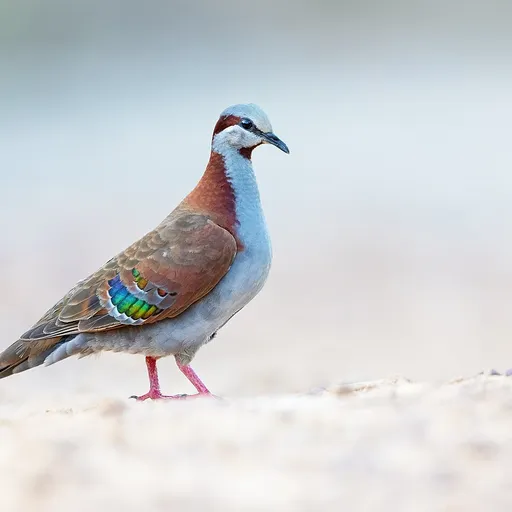
- Plumage: Dark-olive brown on top, rich chestnut along the nape and shoulder, and blue-grey underparts.
- Markings: Features iridescent bars of blue and green across the inner secondary feathers of each wing.
- Voice: Emits a low, repeated 'hoop' or 'whoo' call during vocal advertisement.
Habitat
This species inhabits dense coastal heathland, wet or dry sclerophyll forests, woodlands, and some mallee areas where thick shrub layers provide cover. Its range includes the south-west and south-east of the Australian mainland, with populations in Queensland, New South Wales, Victoria, South Australia, Western Australia, and Tasmania.
Diet
The brush bronzewing feeds on seeds, berries, and small insects, foraging primarily on the ground often singly or in pairs. It swallows small pieces of grit and pebble to aid the grinding of seeds within the gizzard and approaches watering holes cautiously at dawn or dusk.
Did you know?
Feeding on Gastrolobium plants renders these birds toxic to non-native mammalian predators such as cats and foxes. This chemical defence appears to contribute to the maintenance of biodiversity in south-west Western Australia by limiting predation on these ground-dwelling birds.
Sources
- Wikipedia · CC BY-SA 4.0
- Wikidata · CC0 1.0