
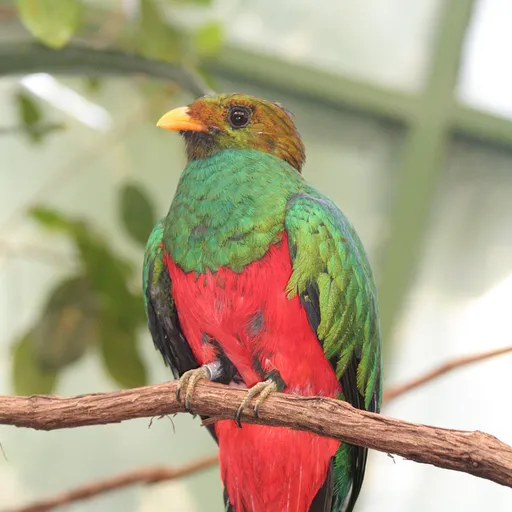
Golden-headed Quetzal
Pharomachrus auriceps
Least Concern
Overview
The golden-headed quetzal, also known as the corequenque, is a strikingly coloured bird found in moist mid-elevation forests from eastern Panama to northern Bolivia. It belongs to the genus Pharomachrus and is part of the family Trogonidae, which includes birds native to tropical rainforests worldwide.
Identification
- Iridescent golden-green wings and breast that can appear blue depending on the light, with a brilliant red lower breast.
- A distinctive golden-bronze head in males, while females display a duller golden-brown head and brownish breast.
- Short and broad bill that appears yellow in males and brownish greyish in females.
- Heterodactyl feet with olive green or brownish legs, featuring the first and second toes facing backwards and the third and fourth toes facing forward.
Habitat
Golden-headed quetzals inhabit humid and wet moderate-elevation montane and foothill forests, occasionally appearing in temperate cloud forests and elfin forests. They reside at elevations ranging from 1,200 m to 3,100 m across Central and South America, specifically from eastern Panama through the Andes of Venezuela, Colombia, Peru, and northern Bolivia.
Diet
The diet consists mainly of fruit, which accounts for 87.5% of stomach contents, with arthropods making up the remainder. Although it was once thought they fed on small vertebrates such as frogs and lizards, observations confirm that they primarily consume insects alongside fruit. This fruit-heavy diet makes the species crucial for the dispersal of fruit seeds.
Did you know?
Unlike most trogons, the golden-headed quetzal maintains a clean nest by either removing or swallowing all droppings. The male is unique among quetzals for lacking a crest of head feathers.
Sources
- Wikipedia · CC BY-SA 4.0
- Wikidata · CC0 1.0