
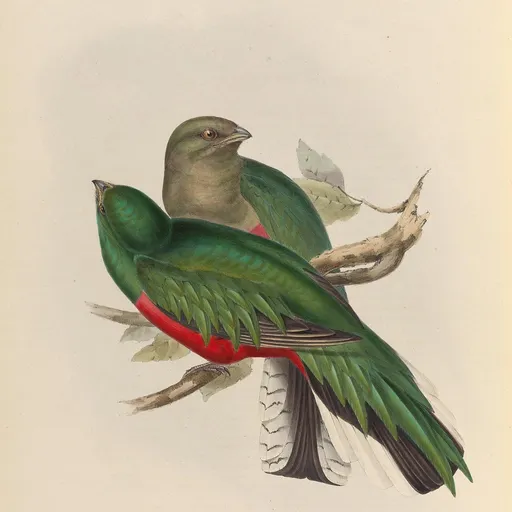
White-tipped Quetzal
Pharomachrus fulgidus
Least Concern
Listen
XC855492 · Rosa Elena Albornoz · San Antonio De Los Altos (near Parroquia Macarao), Municipio Los Salias, Miranda, Venezuela · CC0 1.0
Overview
The white-tipped quetzal (Pharomachrus fulgidus) is a species of bird in the family Trogonidae, endemic to northern South America. It is found in Venezuela, Colombia, and Guyana and is currently listed as Least Concern on the IUCN Red List.
Identification
- Adult males possess a golden, green-bronze crown and nape with a bright green breast, back, and rump, contrasting with striking red under tail-coverts and belly.
- The wings and upper tail are black, while the under tail appears white due to broad, white-backed outer rectrices that occupy about a third of their length.
- Males feature a short crest formed by elongated forehead feathers, a butter-yellow bill, and brownish-black feet.
- Females are less iridescent, lacking the frontal crest, with brown-grey throat, belly, and breast bordered by a green band and yellowish-brown to grey bills and feet.
Habitat
This species inhabits upper tropical and subtropical zones, occurring in a wide variety of environments including subtropical to temperate forests, cloud forests, secondary growth, forest edges, moist ravines, and coffee plantations. It is found at altitudes of 900–1900 m in Venezuela and 1500–2500 m in Colombia, though it has been reported as low as 725 m. In Guyana, the bird is rarer and tends to inhabit the densest areas of deep forest ravines known as barrancas.
Diet
The white-tipped quetzal feeds primarily on fruits and berries, which it collects by sallying from a perch, hovering to grab the item, and then returning to the perch to consume it. On one occasion, an individual was observed eating a large lizard. Their wide bills and weak legs are adaptations that reflect this diet within arboreal areas.
Did you know?
Despite their striking and beautiful bright feathers, these birds often appear inactive to avoid predation, compensating for their visibility by sheltering their colours and using flexible necks that can turn through 180 degrees to keep watch.
Sources
- Wikipedia · CC BY-SA 4.0
- Wikidata · CC0 1.0