
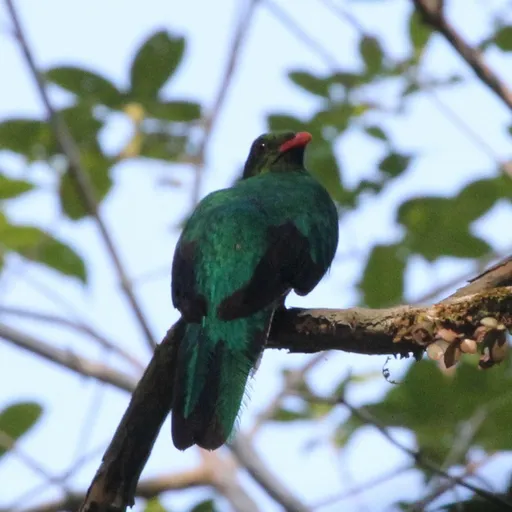
Pavonine Quetzal
Pharomachrus pavoninus
Least Concern
Overview
The pavonine quetzal (Pharomachrus pavoninus), also known as the peacock trogon, is a species of bird in the family Trogonidae. It is the only quetzal species that inhabits the lowland rainforests east of the Andes. This species is found year-round in the northern region of the Amazon basin across South America.
Identification
- Males feature iridescent green plumage on the back and upperparts, a golden brown to green head, and a brilliant red belly, contrasted with black wings and tail.
- The male bill is red, turning yellow at the tip, while the female has a grey bill with a black tip and duller, buff-coloured plumage.
- Both sexes possess elongated upper tail coverts that extend over the rounded tail feathers, which in females display a black and white barred pattern.
- The primary call is a descending whistle repeated four times in ten seconds, followed by a 'chok' note, alongside a chattering alarm call.
Habitat
The pavonine quetzal resides in the terra firme forests of the Amazon basin, spanning from southeastern Colombia and eastern Ecuador through Peru to northern Bolivia and Brazil. It is restricted to the lower and middle understory of lowland rainforests, typically ranging between sea level and 1200m in elevation, and remains highly arboreal, only occasionally descending to the forest floor.
Diet
This species is primarily a frugivore, with stomach contents analysis showing most adults consume solely fruit. Juveniles are fed a mixed diet that includes tree frogs, specifically of the genera Hyla and Phyllomedusa, alongside various fruits from families such as Lauraceae and Annonaceae. As the chicks develop, parents gradually increase the proportion of fruit in their diet until they fledge.
Did you know?
Young males take up to three years to grow their full-length adult plumage, emerging initially with down-like and short tawny feathers. During the first few weeks after hatching, chicks are fed tree frogs by their parents, a dietary component that is significantly reduced as the juveniles mature.
Sources
- Wikipedia · CC BY-SA 4.0
- Wikidata · CC0 1.0