
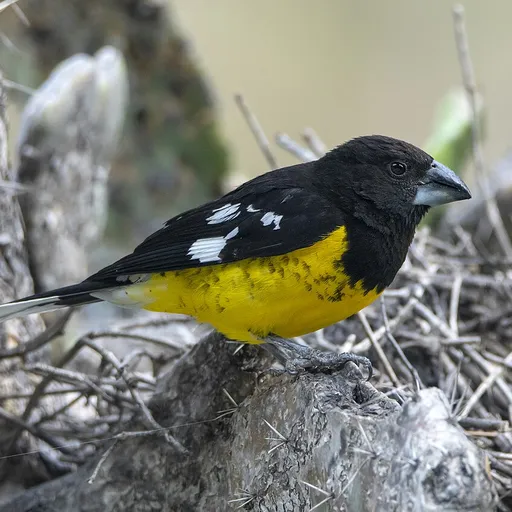
Black-backed Grosbeak
Pheucticus aureoventris
Least Concern
Listen
XC242922 · Niels Krabbe · Chimborazo: Nabuzo, Ecuador · CC BY-SA 4.0
Overview
The black-backed grosbeak, Pheucticus aureoventris, is a passerine bird in the family Cardinalidae native to South America. It is classified as Least Concern by the IUCN, though it is frequently trapped for the cagebird trade.
Identification
- Approximately 22 cm in length, with males displaying black upperparts, a yellow shoulder patch, and white patches on closed wings.
- Bright yellow lower breast and belly in males, with black flecking on the sides, while females appear browner with yellow mottling above and dusky speckles below.
- Song described as a rich, melodious series of whistled notes, accompanied by a sharp 'keck' call.
Habitat
Inhabiting the eastern Andes, this species prefers dry to very dry woodland, ranging from scrubby to open environments, and is often found in gardens. It is distributed across Argentina, Brazil, Bolivia, Colombia, Ecuador, Paraguay, Peru, and Venezuela, typically occupying elevations between 600 m and 3,700 m depending on the location.
Diet
The bird feeds on berries, seeds, flowers, and insects, typically foraging singly or in pairs, though several may gather in fruiting trees. It mostly forages high up in trees but can be observed at any level and does not join mixed-species foraging flocks.
Did you know?
The plush-crested jay is a frequent predator at the black-backed grosbeak's nest, which is an open cup constructed from vine stalks and lined with fine fibres, placed up to 3 m high in a shrub.
Sources
- Wikipedia · CC BY-SA 4.0
- Wikidata · CC0 1.0