
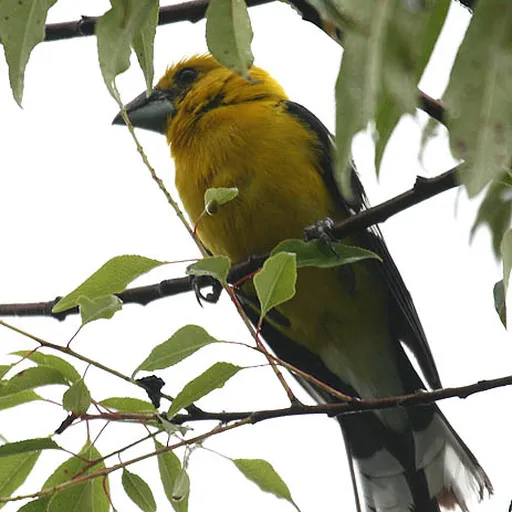
Golden Grosbeak
Pheucticus chrysogaster
Least Concern
Listen
XC1165207 · Rosa Elena Albornoz @rosaelena_naturaleza · San Antonio De Los Altos (near Parroquia Macarao), Los Salias, Miranda, Venezuela · CC0 1.0
Overview
The golden grosbeak, Pheucticus chrysogaster, is a bird in the family Cardinalidae found in Colombia, Ecuador, Peru, and Venezuela. It is classified as a species of Least Concern by the IUCN, though its population is believed to be decreasing.
Identification
- Males feature an orange-tinged deep yellow head and nape, a black back, and bright yellow underparts, while females have a duller yellow crown with heavy black streaks.
- The species measures approximately 21.5 cm in length and weighs between 54 and 60 g.
- It possesses a massive bill with a black maxilla and a bluish gray mandible, along with bluish gray legs and feet.
- The song is described as rich and melodious, often delivered from a prominent perch, while the call is noted as a metallic pink.
Habitat
The golden grosbeak inhabits generally dryish and somewhat open landscapes, including forest edges, woodlands, scrublands, pastures, and gardens, as well as more humid areas on the eastern side of the Andes in Peru. Its range extends from the Sierra Nevada de Santa Marta in northern Colombia south along the Andes to Peru, at elevations varying from near sea level to 3,500 m.
Diet
The diet includes insects, seeds, and berries, though it has not been extensively studied. The bird usually forages singly or in pairs, taking food from foliage fairly high in the habitat, and generally avoids joining mixed-species feeding flocks.
Did you know?
The genus name Pheucticus derives from Greek and means "shy". The shiny cowbird is a frequent brood parasite of this species.
Sources
- Wikipedia · CC BY-SA 4.0
- Wikidata · CC0 1.0