
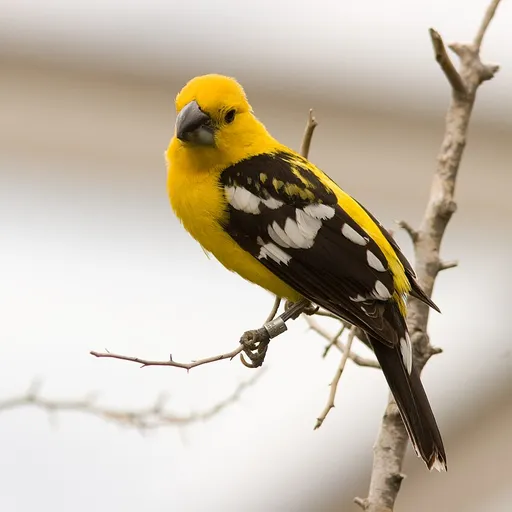
Yellow Grosbeak
Pheucticus chrysopeplus
Least Concern
Overview
The yellow grosbeak (Pheucticus chrysopeplus) is a bird in the family Cardinalidae found primarily in Mexico and Guatemala. It is the largest member of its genus in Mexico and Central America and is assessed as Least Concern by the IUCN, though its population is believed to be decreasing.
Identification
- Males of the nominate subspecies have a deep yellow head, nape, and breast, with brighter yellow on the back and rump, and black wings and tail with wide white tips.
- Females are duller than males, featuring heavy black streaking on the crown, nape, and ear coverts, and brownish tails.
- The bird possesses a massive bill with a blackish maxilla and a pinkish to bluish gray mandible, along with bluish gray legs and feet.
- The song is described as a series of rich, clear whistles, such as 'chee wee chee-r weer weeuh' or a short, sweet warble, accompanied by calls like 'plihk' or a loud 'Peeek!'.
Habitat
The species inhabits a variety of landscapes, including deciduous and semi-deciduous forest, gallery forest, scrubby woodlands, and thorn forest. It has a disjunct distribution along the Pacific sides of Mexico and Guatemala, occurring from sea level up to 2,500 m in Mexico and 300 to 1,850 m in Guatemala. It also occurs occasionally in Arizona, with documented vagrant records as far north as Colorado and east as Arkansas.
Diet
The yellow grosbeak feeds on fruits and nectar. It usually forages singly or in pairs and rarely joins mixed-species feeding flocks.
Did you know?
The population in Sonora departs south in mid-September and returns in mid-May, but it is currently unknown where these birds overwinter.
Sources
- Wikipedia · CC BY-SA 4.0
- Wikidata · CC0 1.0