
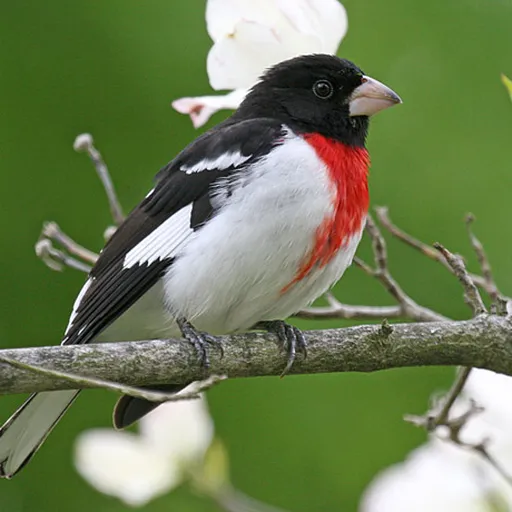
Rose-breasted Grosbeak
Pheucticus ludovicianus
Least Concern
Listen
XC178124 · Jonathon Jongsma · Wild River State Park, Chisago County, Minnesota, United States · CC BY-SA 4.0
Overview
The rose-breasted grosbeak (Pheucticus ludovicianus), colloquially known as the "cut-throat," is a large, seed-eating bird in the cardinal family. It is classified as Least Concern by the IUCN and is characterised by marked sexual dimorphism, particularly in the male's striking plumage.
Identification
- Males in breeding plumage feature black heads, wings, and backs with a bright rose-red patch on a white breast, while winter plumage appears scaly with brown fringes and white underparts.
- Females possess dark grey-brown upperparts, white supercilia, buff head stripes, and black-streaked white underparts with a buff tinge, distinguishing them from similar species like the black-headed grosbeak.
- Adults measure 18–22 cm in length with a wingspan of 29–33 cm, possessing a dusky horn-coloured beak and dark feet and eyes.
- The song is a subdued, mellow warbling resembling a refined American robin, while the call is a sharp "pink" or "pick" reminiscent of a woodpecker.
Habitat
Breeding occurs in cool-temperate open deciduous woods across much of Canada and the northeastern United States. During winter, the species migrates south through the United States east of the Rocky Mountains to winter in central-southern Mexico, Central America, and parts of South America and the Caribbean. Winter habitats prefer more open woodland, forest edges, parks, and gardens, ranging from sea level up to 1,500 m in elevation.
Diet
Primarily a foliage gleaner, the bird forages in shrubs and trees for insects, seeds, and berries, often catching insects in flight and occasionally eating nectar. It usually stays in the treetops, with stomach contents in the north-central United States and southern Canada consisting largely of invertebrates, predominantly beetles, along with wild fruits and weed seeds. In winter quarters, they may be attracted to bird feeders and consume fruit such as blackberries, mulberries, and sunflower seeds.
Did you know?
Rose-breasted grosbeaks are capable of recognising the eggs of the brood parasite brown-headed cowbird and have been observed aggressively displacing cowbirds near their nests. Although frequently targeted, fewer than 7% of nests contained cowbird eggs in one specific study.
Sources
- Wikipedia · CC BY-SA 4.0
- Wikidata · CC0 1.0