
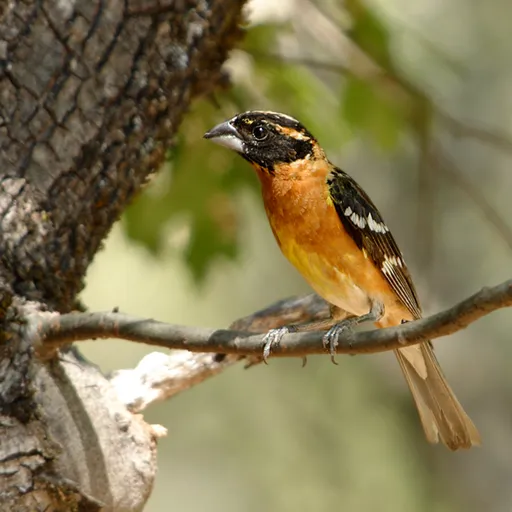
Black-headed Grosbeak
Pheucticus melanocephalus
Least Concern
Listen
XC724724 · Spenser Williams · Dixon, Rio Arriba County, New Mexico, United States · CC0 1.0
Overview
The black-headed grosbeak (Pheucticus melanocephalus) is a medium-sized, seed-eating bird in the family Cardinalidae. It is a migratory species that is sometimes considered conspecific with the rose-breasted grosbeak, with which it hybridises on the American Great Plains.
Identification
- Males possess a black head, black wings and tail with prominent white patches, a dark to tawny orange breast, and a yellow belly.
- Females have a brown head, neck, and back marked with sparrow-like black streaks, white streaks on the head and cheeks, a white breast, and greyish-brown wings and tail featuring two white wing bars.
- Approximately 19 cm long, the bird is similar in size to a common starling.
- Its song is a rich warble similar to an American robin but more fluent, faster, softer, and mellow, with rising and falling passages.
Habitat
This species prefers deciduous and mixed wooded areas with large trees and thick bushes, including streamside corridors, river bottoms, lakeshores, wetlands, and suburban areas. Its range extends from southwestern British Columbia through the western half of the United States into central Mexico, with vagrants occurring further south in Central America.
Diet
The black-headed grosbeak feeds on pine and other seeds, berries, insects, spiders, and fruit, foraging in foliage, on the ground, or in low vegetation. In winter, it consumes large quantities of poisonous monarch butterflies, a trait facilitated by its physiological insensitivity to cardiac glycosides. It is also a frequent visitor to bird feeders for sunflower seeds, fruit, and grape jelly.
Did you know?
The bird exhibits a rare case of convergent evolution, possessing genetic changes in the sodium pump protein that render it resistant to the heart poisons found in monarch butterflies. These specific mutations at positions 111 and 119 are shared with certain insects and butterflies that feed on milkweed, allowing the grosbeak to consume over a million monarchs per year in some colonies.
Sources
- Wikipedia · CC BY-SA 4.0
- Wikidata · CC0 1.0