
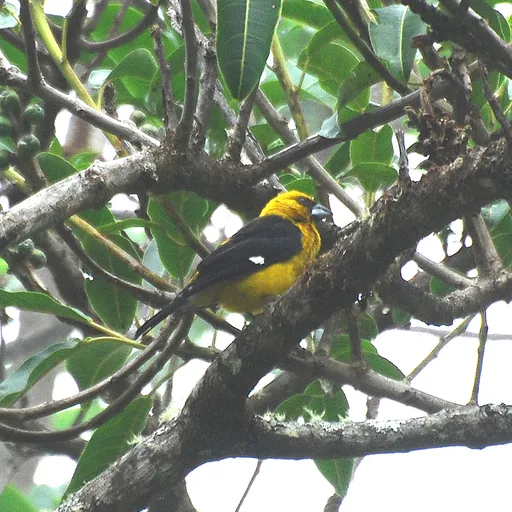
Black-thighed Grosbeak
Pheucticus tibialis
Least Concern
Overview
The black-thighed grosbeak (Pheucticus tibialis) is a bird in the family Cardinalidae, native to the regions of Costa Rica and Panama. It is classified as a species of Least Concern by the IUCN, though its population is estimated to be decreasing.
Identification
- Adult males feature a bright yellow head, nape, and upper mantle, contrasting with a black lower mantle edged in yellow and a deep yellow breast mottled with darker shades.
- The species measures approximately 20 cm in length and weighs an average of 62 g, distinguished by black thigh feathers and a large white flash on the primaries.
- Both sexes possess a massive bill with a black maxilla and gray mandible, along with lead-gray legs and feet.
- The song is described as a cheerful series of rich, varied musical whistles that may end in a rapid trill or an emphatically repeated note, accompanied by a sharp 'pik' call.
Habitat
Found from Volcán Miravalles in northern Costa Rica south through the Cordillera Central and Cordillera de Talamanca into western Panama, this species inhabits forest edges, clearings, pastures with trees, and gardens. In Costa Rica, it typically ranges between 1,000 and 2,600 m in elevation, while in Panama it is mostly found between 750 and 1,200 m, though it can occur at higher altitudes in Chiriquí Province.
Diet
The black-thighed grosbeak feeds on seeds, fruits, and invertebrates, foraging primarily in the upper levels of its habitat but occasionally descending to feed lower. It usually takes food from the tips of branches but is also known to catch insects in mid-air.
Did you know?
The nest is a cup constructed from rootlets on a base of twigs and moss, typically placed in a small tree or vine tangle between 3 and 9 m above the ground, holding a clutch of two pale blue eggs with darker spots.
Sources
- Wikipedia · CC BY-SA 4.0
- Wikidata · CC0 1.0