
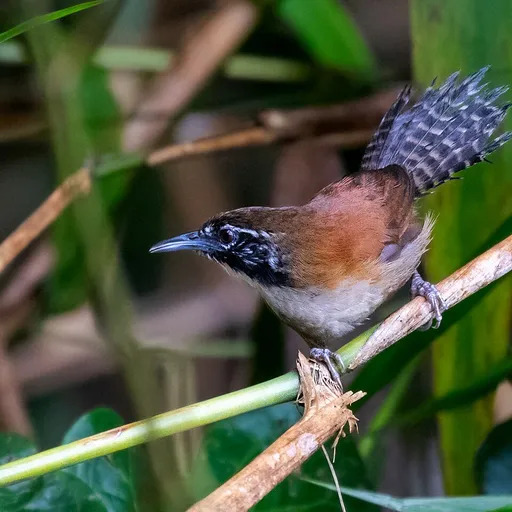
Coraya Wren
Pheugopedius coraya
Least Concern
Listen
XC242934 · Niels Krabbe · Pastaza: Canelos, Ecuador · CC BY-SA 4.0
Overview
The coraya wren (Pheugopedius coraya) is a medium-sized bird in the family Troglodytidae, found in Amazonian northern and northwestern South America. First described in 1789 by Johann Friedrich Gmelin, the species name is derived from the French queue rayée, meaning 'barred tail'.
Identification
- Plumage: Overall rufous-(chestnut)-brown body with darker brown on the back and deep brown-blackish wings; lighter buff-brown sides and a buff-white breast.
- Head: Entirely black head flecked with white feathers, featuring a narrow bright white eye stripe and a narrow white eye ring.
- Tail: A medium-length, black-and-white banded tail.
- Structure: Medium-sized wren with a medium-length black decurved bill, black eyes, and gray-black legs.
Habitat
The coraya wren inhabits subtropical or tropical moist lowland forests, swamps, and heavily degraded former forests across the northern Amazon Basin and the Guianas. Its range extends through Venezuela, Colombia, Ecuador, Peru, Brazil, Guyana, French Guiana, and Suriname, including the downstream sections of the Tapajós, Xingu, and Araguaia-Tocantins river systems in Brazil.
Did you know?
The common name 'coraya' is a homophone for the French queue rayée, which translates to 'barred tail', a direct reference to the bird's distinctive medium-length black-and-white banded tail.
Sources
- Wikipedia · CC BY-SA 4.0
- Wikidata · CC0 1.0