
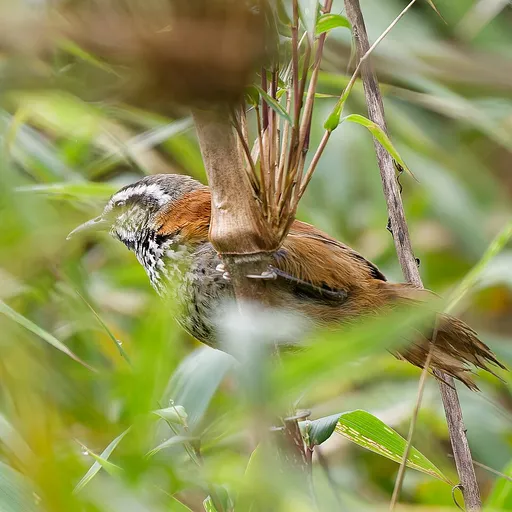
Inca Wren
Pheugopedius eisenmanni
Least Concern
Overview
The Inca wren (Pheugopedius eisenmanni) is a monotypic species of bird in the family Troglodytidae that is endemic to Peru. Classified as Least Concern on the IUCN Red List, its population is believed to be increasing despite its small geographic range.
Identification
- Measures 14.5 to 15.5 cm in length, with males weighing 22.0 to 27.0 g and females 19.0 to 23.0 g.
- Adult males feature a dull black crown, a broad white supercilium, bright russet shoulders and back, and bold black streaks on a white breast.
- Adult females possess a charcoal gray crown, restricted breast streaking, and a tail with fewer bars than the male.
- Juveniles appear duller overall with a brown crown and unstreaked light grayish brown underparts.
Habitat
Found exclusively in a small area of Peru's Department of Cuzco on the eastern side of the Andes, between elevations of 1,700 and 3,350 m. It inhabits the under and middle stories of humid montane forest and its edges, with a particular preference for dense stands of Chusquea bamboo.
Diet
This insectivorous species forages near the ground within bamboo and other dense foliage. It typically forages in pairs but may also be seen in groups of up to six individuals, while rarely joining mixed-species foraging flocks.
Did you know?
Curiously, this species was not detected by professionals until the 1960s and was not described until 1985, despite being regularly encountered at Machu Picchu. It is unusual among birds in that males and females sing duets, producing a rich, varied, warbled series of whistled phrases.
Sources
- Wikipedia · CC BY-SA 4.0
- Wikidata · CC0 1.0