
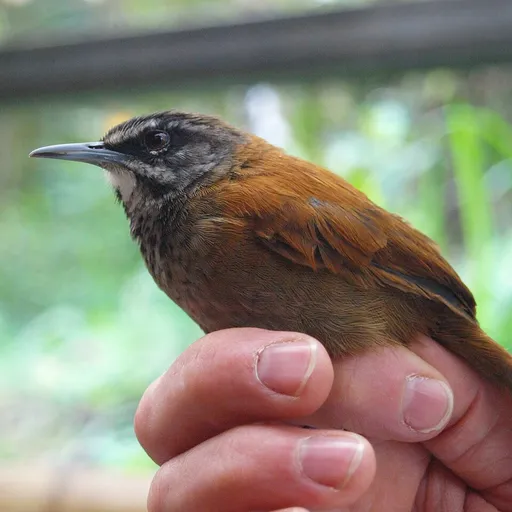
Plain-tailed Wren
Pheugopedius euophrys
Least Concern
Listen
XC242935 · Niels Krabbe · Loja: Cajanuma, Ecuador · CC BY-SA 4.0
Overview
The plain-tailed wren (Pheugopedius euophrys) is a species of songbird belonging to the family Troglodytidae. It is characterised as a bamboo specialist that inhabits subtropical or tropical moist montane forests in the Andes. The species is currently listed as Least Concern on the IUCN Red List and is common within its limited range.
Identification
- A relatively large wren with a rufous back, wings, and tail that feature an olive cast on the back.
- Distinctive head pattern comprising gray with black and white stripes, including superciliary, malar, and submalar stripes.
- Underparts are buffy-gray, though western populations show heavy black spotting on the breast while eastern populations lack these markings.
- Possesses a slightly decurved gray bill and a short, plain tail that lacks the barring typical of the family.
Habitat
Found in the Andes of southern Colombia, Ecuador, and northern Peru, primarily between elevations of 2,200 and 3,200 metres. The bird lives almost exclusively in chusquea bamboo thickets within moist montane forests and also frequents recently disturbed areas such as fresh landslides where insect activity increases.
Diet
The plain-tailed wren is mainly insectivorous, though its diet occasionally includes seeds and berries. It typically forages on or near the ground within the chusquea bamboo undergrowth in search of invertebrates.
Did you know?
The species is renowned for its complex duetting behaviour, where pairs or groups of up to seven individuals alternate syllables so rapidly that the chorus sounds as if it is being produced by a single bird. Research indicates that the brains of both partners process the entire duet rather than just their own contribution.
Sources
- Wikipedia · CC BY-SA 4.0
- Wikidata · CC0 1.0