
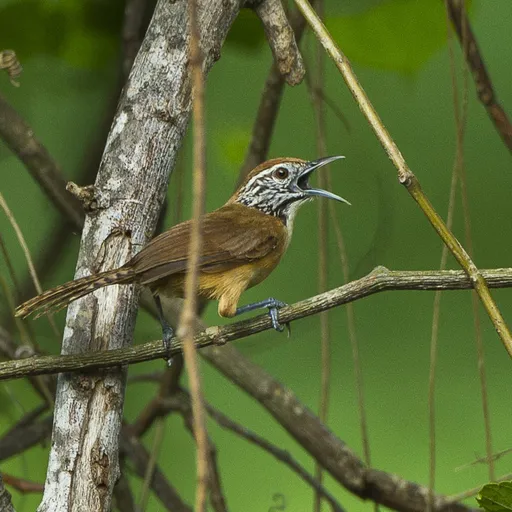
Happy Wren
Pheugopedius felix
Least Concern
Listen
XC580372 · Jovani León · Bachomobempo, Ahome, Sinaloa, Mexico · CC BY-SA 4.0
Overview
The happy wren (Pheugopedius felix) is a species of bird in the family Troglodytidae that is endemic to the Pacific slope of western Mexico and nearby islands. It is currently classified as Least Concern on the IUCN Red List.
Identification
- Small wren measuring 12.5–14 cm in length.
- Features chestnut upperparts and cream underparts.
- Possesses a black and white striped face.
- Characterised by a downward-curving bill.
- Produces a complex song described as a "rollicking, gurgling whistle."
Habitat
This species inhabits subtropical or tropical dry and moist lowland forests, dry shrubland, and heavily degraded former forest. Its range is restricted to the Pacific slope of western Mexico from Sonora to Oaxaca, as well as islands west of the Mexican coast, with six recognized subspecies showing significant geographical variation.
Diet
The happy wren is primarily insectivorous but may also consume vegetable matter, including fruit. It typically forages less than two metres from the ground, although it occasionally forages up to ten metres high.
Did you know?
The species often constructs its nest near wasp nests or within an Acacia tree that is defended by Pseudomyrmex ants. Pairs of happy wrens primarily use duet songs for cooperative territory defense.
Sources
- Wikipedia · CC BY-SA 4.0
- Wikidata · CC0 1.0