
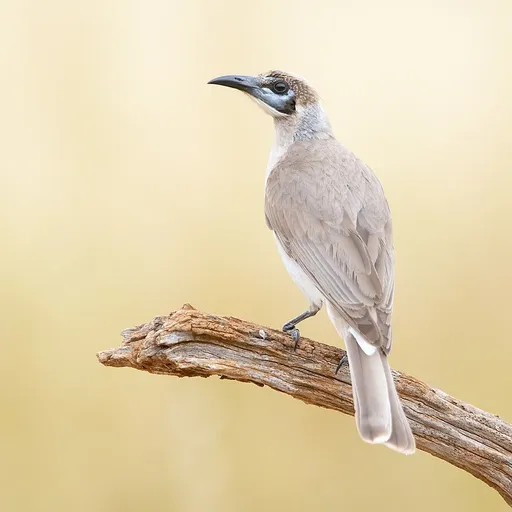
Little Friarbird
Philemon citreogularis
Least Concern
Listen
XC1069806 · Rob Nicholson · Greenup Meeting Place, 40 Greenup Limevale Rd, Coolmunda, Queensland, Australia · CC BY 4.0
Overview
The little friarbird (Philemon citreogularis), also known as the little leatherhead or yellow-throated friarbird, is the smallest member of the Philemon genus. It lives a prominent and vocal existence, often seen high in trees chasing other honeyeaters, and is classified as Least Concern on the IUCN Red List.
Identification
- Measures 25–30 cm in length with an average weight of 67 g; males are larger than females but similar in appearance.
- Distinguished by the absence of a casque and bare blue skin under the eye that widens over the cheek, bordered by dark feathers.
- Plumage is dark grey-brown above with a dull white fringe on the nape flowing to the side of the neck, and fine silky white feathers under the chin with silvery white streaks on the breast.
- Emits a distinct, liquid 'gee-wit' or 'chewip' call, with breeding songs including chattering scoldings.
Habitat
Found throughout northern and eastern Australia, as well as southern Papua New Guinea and adjacent islands, with seasonal movements to south-east Australia during summer. It predominantly inhabits swamp woodlands, mangroves, shrub communities, and open eucalypt forests, usually near water bodies, but also visits orchards and vineyards during flowering seasons.
Diet
Feeds on nectar, blossoms, fruit, invertebrates, and seeds, often joining mixed groups of other honeyeaters in trees. It is rarely seen feeding on the ground, preferring to forage in the canopy.
Did you know?
Juvenile birds are often described by the term 'citreogularis', referring to their washed yellow fore-neck, throat, and upper breast with yellow spots on the side of the breast.
Sources
- Wikipedia · CC BY-SA 4.0
- Wikidata · CC0 1.0