
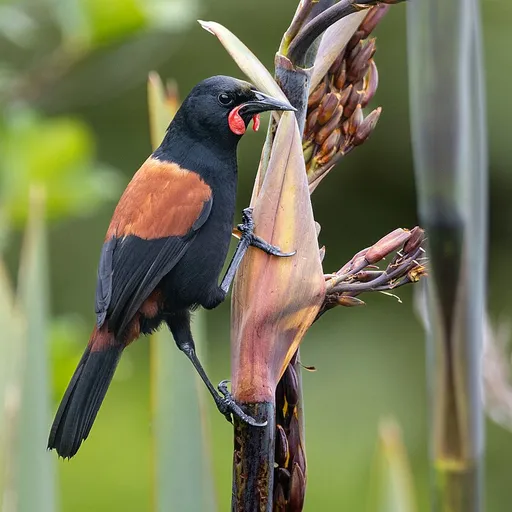
North Island Saddleback
Philesturnus rufusater
Near Threatened
Overview
The North Island saddleback (Philesturnus rufusater) is a forest-dwelling passerine bird species endemic to the North Island of New Zealand. Known in Māori as tīeke, it is currently classified as Near Threatened by the IUCN and as a relict species in the New Zealand Threat Classification System.
Identification
- Mostly black plumage with chestnut on the saddle, rump, and tail coverts, distinguished from the South Island species by a faint yellow lining on the superior edge of the saddle.
- Average length of 25 cm, with males weighing around 80 g and females around 69 g; males possess longer bills and larger wattles.
- Starling-like black bill with orange-red wattles hanging from its base.
- Calls described as 'cheet, te-te-te-te' or 'ti-e-ke-ke-ke-ke', which is the origin of its Māori name.
Habitat
Naturally occupies lowland broadleaf and coastal evergreen forests, though translocations have established them in various other forest environments. Historically widespread on the North Island mainland and offshore islands before being reduced to a single island, Hen Island, by the 1890s. The population has since increased to approximately 10,000 across numerous offshore islands, Lake Rotorua, and mainland sanctuaries.
Diet
Diet primarily consists of insects, other invertebrates, berries, and nectar. The bill is strong enough to force open dead wood to expose insects such as grubs. Foraging occurs at all heights in forests, but the birds tend to spend most of their time on the forest floor browsing in leaf litter.
Did you know?
The bird's Māori name, tīeke, is derived directly from the sound of its call. The genus name Philesturnus is a portmanteau of Philemon (friarbirds) and Sturnus (starlings).
Sources
- Wikipedia · CC BY-SA 4.0
- Wikidata · CC0 1.0