
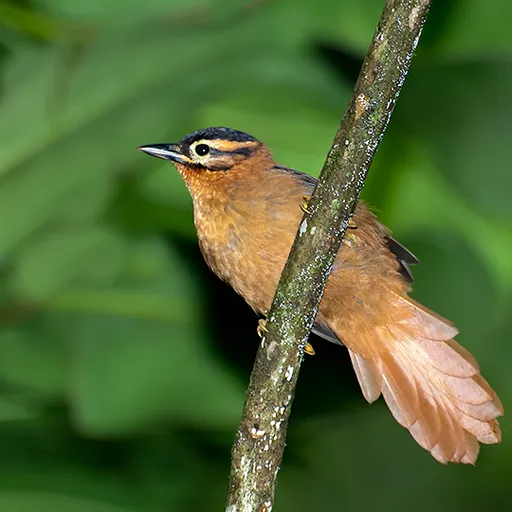
Black-capped Foliage-gleaner
Philydor atricapillus
Least Concern
Overview
The black-capped foliage-gleaner (Philydor atricapillus) is a species of bird in the ovenbird family Furnariidae. It is found in tropical regions of South America and is currently classified as Least Concern on the IUCN Red List, though its population is believed to be decreasing.
Identification
- A 16 to 17 cm long bird with a dramatic facial pattern, featuring a wide pale buff eyering and supercilium that becomes more orange-rufous towards the rear.
- Dark brown crown with faint spots and streaks, contrasted by a rich rufous-brown back and bright orange-rufous uppertail coverts and tail.
- Plain dark orange-rufous breast and belly, with wings that are mostly rich brown with darker coverts.
- Song consists of a rapid series of six to eight very high notes, described as a somewhat musical, whistled, and sharply descending trill.
Habitat
Inhabits tropical evergreen and mature secondary forests from sea level up to 1,000 m in elevation. Its range extends from Bahia in Brazil south through Mato Grosso do Sul and Rio Grande do Sul, into eastern Paraguay and slightly into northeastern Argentina's Misiones Province.
Diet
Feeds on a wide variety of adult and larval arthropods, with a strong preference for adult Lepidoptera, and occasionally eats Coleoptera and spiders. It acrobatically works along branches to glean prey from live and dead leaves, bark, and crevices, particularly favouring bromeliads. Often forages in mixed-species flocks at all levels of the forest.
Did you know?
Almost nothing is known about its breeding biology, except for anecdotal reports that its nest is located in a hole in an earthen bank. Despite deforestation reducing its habitat area, the species seems able to persist in small forest fragments and moderately degraded forests.
Sources
- Wikipedia · CC BY-SA 4.0
- Wikidata · CC0 1.0