
Black-spotted Bare-eye
Phlegopsis nigromaculata
Least Concern
Overview
The black-spotted bare-eye (Phlegopsis nigromaculata) is a passerine bird classified within the typical antbirds subfamily Thamnophilinae. Classified as Least Concern by the IUCN, this insectivorous species inhabits humid forests across South America, though its population is believed to be decreasing.
Identification
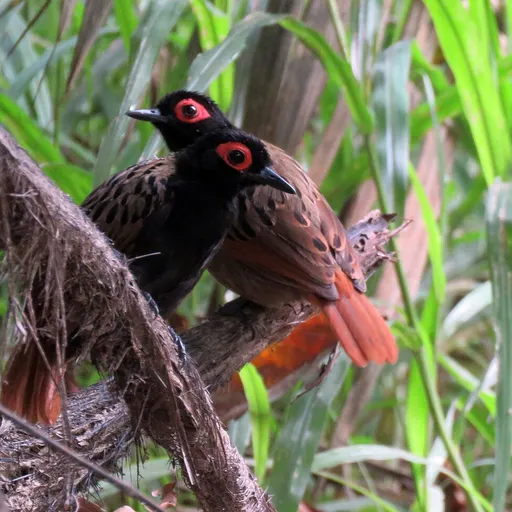
- Males and females alike possess a large ring of bare red skin around the eye.
- The nominate subspecies features a black head, neck, and upper belly, with light olive upperparts marked by black spots edged in pale yellowish olive-brown.
- Flight feathers are cinnamon-rufous and the tail is rufous-chestnut, while underparts transition from black at the breast to olive-brown and then to cinnamon-rufous near the tail.
- The song consists of a short series of moderately long, flat, and rich whistles that slightly lower in pitch and become harsher in quality.
Habitat
Found in Bolivia, Brazil, Colombia, Ecuador, and Peru, the species inhabits humid evergreen forest in lowlands and foothills. In western regions it favours várzea, while further east it occupies terra firme, igapó, and transitional zones. Elevations range from near sea level up to 800 m in Peru, though it remains below 600 m across most of its range in Brazil.
Diet
An obligate ant follower, it feeds on arthropods fleeing foraging army ant swarms. It typically forages individually, in pairs, or in family groups, perching close to the ground before pouncing or sallying after prey, and occasionally flips leaves to find food. It is dominant over most ant followers but subordinate to some congeners.
Did you know?
The bird’s specific epithet, nigromaculata, is derived from Latin words meaning 'black' and 'spotted', directly referencing its most distinctive plumage. The species is also a year-round resident throughout its entire range.
Sources
- Wikipedia · CC BY-SA 4.0
- Wikidata · CC0 1.0