
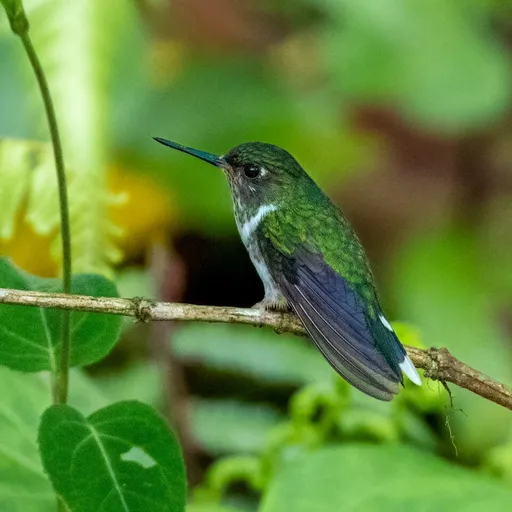
Ecuadorian Piedtail
Phlogophilus hemileucurus
Least Concern
Listen
XC251352 · Niels Krabbe · Napo: Napo Galeras, Ecuador · CC BY-SA 4.0
Overview
The Ecuadorian piedtail (Phlogophilus hemileucurus) is a species of hummingbird in the 'coquettes' tribe Lesbiini of the subfamily Lesbiinae. It is found in Colombia, Ecuador, and Peru, and is assessed by the IUCN as being of Least Concern.
Identification
- Measures 7.3 to 7.6 cm in length and weighs 2.2 to 3.7 g.
- Features a short, straight, black bill with a yellowish base.
- Upperparts are grass green with a greenish brown crown, and a white spot behind the eye.
- Throat and breast are white with green spots, separated by a white band; the tail is blue with white bases and tips, while the innermost feathers are blue-green.
- Song consists of three high-pitched buzzy notes followed by continuous twittering, such as 'tzeeeee...tzeee.tzew..tititititi'.
Habitat
The Ecuadorian piedtail is found in the eastern foothills of the Andes, ranging from the Putumayo and Cauca departments of Colombia, through eastern Ecuador, to the San Martín and Loreto departments of northeastern Peru. It inhabits primary forest edges and secondary forest at elevations between 500 and 1,200 m.
Diet
This bird forages between 2 and 4 m above the ground, perching to take nectar from flowers and to glean small insects from foliage.
Did you know?
The breeding season, which spans from December to April, involves the construction of a cup-shaped nest from fine rootlets and fern leaves, placed 2 to 3 m above the ground in vines or under overhanging thickets.
Sources
- Wikipedia · CC BY-SA 4.0
- Wikidata · CC0 1.0