
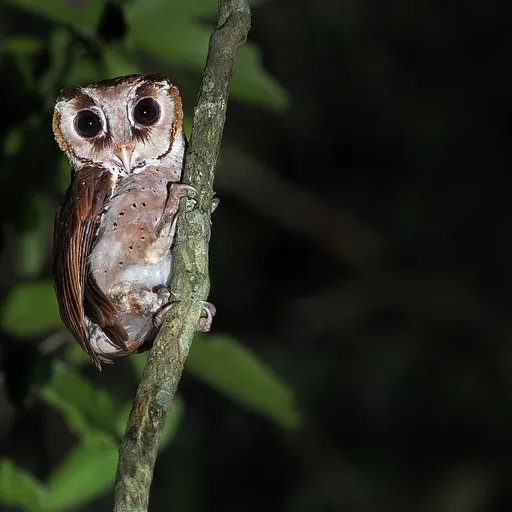
Oriental Bay Owl
Phodilus badius
Least Concern
Overview
The Oriental bay owl (Phodilus badius) is a small, completely nocturnal bird found throughout Southeast Asia and parts of India. It is currently classified as Least Concern on the IUCN Red List, though it remains very scarcely known even in its areas of origin.
Identification
- Plumage: Deep chestnut on the top and back, contrasting with a cream and tanish underside.
- Head: Heart-shaped face with earlike extensions and a highly angular head structure.
- Eyes: Large, striking black eyes highlighted by facial color contrast.
- Song: Melancholic whistles lasting two to eight seconds with increasing pitch, or short 'kleet-kleet' sounds when moving between places.
- Size: Total body length of 22.5–29 cm, typically standing upright which makes it difficult to spot.
Habitat
Found in tropical moist forests, evergreen forests, plantations, and mangrove swamps across Southeast Asia, parts of India, and Sri Lanka. It inhabits altitudes ranging from 200 m to 2,300 m, including Himalayan foothills, the Western Ghats, and montane forests.
Diet
Preys upon small rodents, bats, birds, snakes, frogs, lizards, and large arthropods such as beetles and spiders. It hunts from a perch and flies through trees, utilizing its short, rounded wings for ease of movement, particularly near water.
Did you know?
The species has a remarkable vocal range, not only hooting but also screaming and producing high-pitched whistles. A population on Samar Island in the Philippines apparently went extinct during the 20th century, with the only known specimen lost in a 1945 bombing raid.
Sources
- Wikipedia · CC BY-SA 4.0
- Wikidata · CC0 1.0