
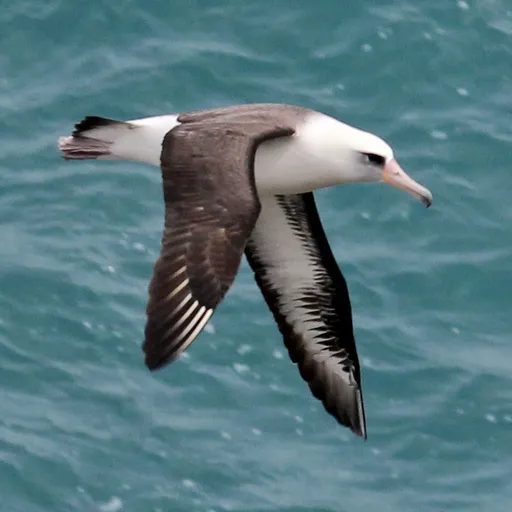
Laysan Albatross
Phoebastria immutabilis
Near Threatened
Overview
The Laysan albatross (Phoebastria immutabilis) is a large seabird that ranges across the North Pacific. This small, gull-like albatross is the second-most common seabird in the Hawaiian Islands, with an estimated population of 1.18 million birds, and is currently expanding its range to new islands.
Identification
- Length averages 81 cm with a wingspan of 195 to 203 cm.
- Blackish-gray upperwing, mantle, back, upper rump, and tail, contrasting with a white head, lower rump, and underparts.
- A black smudge surrounds the eye, and the bill is pink with a dark tip; juveniles have a gray bill and a dark upper rump.
- The underwing pattern varies between individuals, with some having narrower black margins and variable amounts of black in the underwing coverts.
Habitat
The species has a wide range across the North Pacific, with 16 nesting sites, primarily among the Northwestern Hawaiian Islands, particularly Midway and Laysan. Small populations are found on the Bonin Islands near Japan and the bird has begun to colonize islands off Mexico, such as Guadalupe Island and others in the Revillagigedo Archipelago. When away from breeding areas, they range widely from Japan to the Bering Sea and south to 15°N.
Diet
The Laysan albatross feeds predominantly on cephalopods, but also eats fish, crustaceans, and other invertebrates. Chicks are fed regurgitated meals of very rich "stomach oil" and partially digested squid and fish by the parents.
Did you know?
A female Laysan albatross named Wisdom is the oldest known wild bird in the world, first banded in 1956, and in December 2024 she laid her estimated 60th egg. She was observed returning to the atoll with her long-term mate, Akeakamai, since 2006, though recent observations show her interacting with another male.
Sources
- Wikipedia · CC BY-SA 4.0
- Wikidata · CC0 1.0