
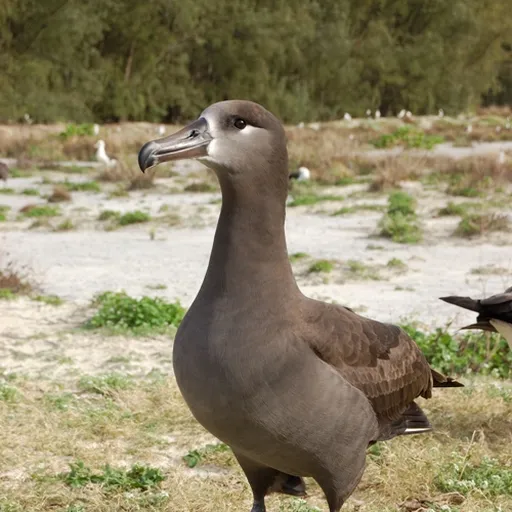
Black-footed Albatross
Phoebastria nigripes
Near Threatened
Overview
The black-footed albatross (Phoebastria nigripes) is a large seabird native to the North Pacific and one of only three albatross species found in the Northern Hemisphere. Unlike many of its relatives, it is distinguished by its predominantly dark plumage and a population concentrated heavily on the isolated Northwestern Hawaiian Islands.
Identification
- Plumage: Almost entirely black, with adults showing white markings around the base of the beak and below the eye; some adults possess white undertail coverts.
- Size: Measures 68 to 74 cm in length with a substantial wingspan of 190 to 220 cm.
- Bill: All-dark bill with white markings at the base that increase in extent as the bird ages.
- Vocalisations: Vocalisations include shrieks and squeals during fights over food, as well as bill-clapping, whistles, groans, and quacks during courtship.
Habitat
While its breeding range is confined to isolated tropical islands such as the Northwestern Hawaiian Islands, Tori Shima, and Isla Guadalupe, the species utilises vast areas of the North Pacific for foraging. It feeds from Alaska to California and Japan, although it shows a preference for the northeastern Pacific Ocean.
Diet
The black-footed albatross forages in pelagic waters, consuming the eggs of flying fish, live fish, fish offal, squid, and occasionally crustaceans. It is also known to ingest floating debris, including plastics, which can occupy stomach space needed for food.
Did you know?
These birds have a remarkably long courtship period, spending two years building nests and engaging in elaborate dances with prospective mates before reproducing, a behaviour that ensures maximum trust between partners before the massive energetic investment of raising a chick.
Sources
- Wikipedia · CC BY-SA 4.0
- Wikidata · CC0 1.0