
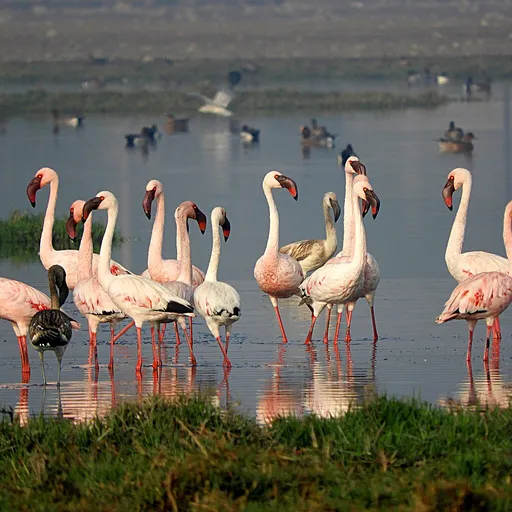
Lesser Flamingo
Phoeniconaias minor
Near Threatened
Overview
The lesser flamingo (Phoeniconaias minor) is the smallest species of flamingo found in sub-Saharan Africa and western India, though it remains a tall and large bird by general standards. Despite being potentially the most common species of flamingo with historical peaks of up to two million birds, it is currently classified as Near Threatened due to declining populations and limited breeding sites.
Identification
- Size and Build: The smallest flamingo species, though still large, standing approximately 80 to 90 cm tall with a wingspan of 90 to 105 cm.
- Plumage: Most of the plumage is pinkish white.
- Bill: Distinguished by much more extensive black on the bill compared to the greater flamingo; the deep bill is specially adapted for filtering tiny food items.
Habitat
This species occurs primarily in sub-Saharan Africa and western India, with occasional vagrants reported further north. It breeds principally in highly caustic, alkaline water bodies such as Lake Natron in Tanzania, Etosha Pan, Makgadikgadi Pan, and Kamfers Dam in Africa, as well as salt pans in northwestern India.
Diet
The bird feeds primarily on Spirulina, an algae that grows exclusively in very alkaline lakes, along with other forms of algae such as Synechocystis and Oscillatoria. Its deep bill filters these tiny food items, and it also consumes small invertebrates like copepods, diatoms, and rotifers to a lesser extent.
Did you know?
Although the algae they consume are blue-green in colour, they contain photosynthetic pigments that are responsible for giving the birds their distinctive pink colour. Chicks join creches that can number over 100,000 individuals, led by a few adults on journeys to fresh water that can exceed 32 km.
Sources
- Wikipedia · CC BY-SA 4.0
- Wikidata · CC0 1.0