
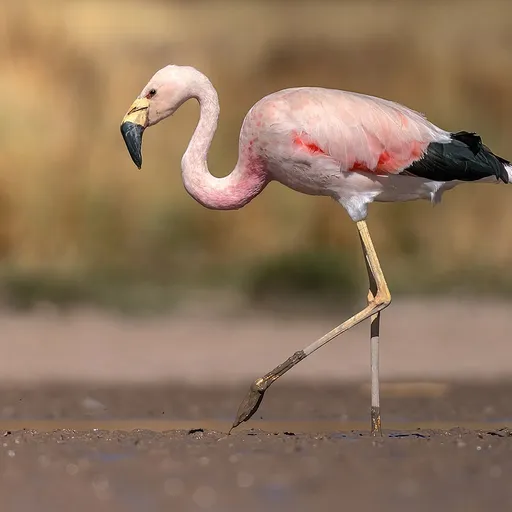
Andean Flamingo
Phoenicoparrus andinus
Vulnerable
Overview
The Andean flamingo, Phoenicoparrus andinus, is a large flamingo species native to the high Andes of South America. It is one of the two heaviest living flamingos and is closely related to James's flamingo. This species is currently classified as vulnerable due to habitat changes caused by mining and human disturbance.
Identification
- Large bird with a pale pink body, deeper vinaceous-pink on the lower neck, breast, and wing coverts, and black primaries and secondaries forming a bold triangle when wings are folded.
- Distinctive yellow legs and three-toed feet, the only flamingo species with this combination.
- Bill is pale yellow near the skull but black for the majority of its length, curving downward with a deeper lower mandible.
- Vocalisations include a surprisingly high-pitched, passerine-like peep, a rough nasal quack, and a quiet, conversational chuckle.
Habitat
Native to the wetlands of the high Andes from southern Peru to northwestern Argentina and northern Chile. The species is migratory, living in salt lakes during summer and moving to lower elevation wetlands in winter. It is sympatric with the Chilean and James's flamingos, often sharing nesting areas.
Diet
Filter feeders that consume a wide range of foods, including diatoms, invertebrates, fish, and microscopic algae. They forage in shallow, salty waters using a deep-keeled bill that facilitates inertial impaction to separate dense food particles from water. Foraging depth strategies can vary depending on whether they are grouped with Chilean or James's flamingos.
Did you know?
The species is highly vulnerable to borax mining, where as little as 5 g of borax can cause skeletal malformations and reproductive toxicity in the birds, while human workers remain unaffected at these levels.
Sources
- Wikipedia · CC BY-SA 4.0
- Wikidata · CC0 1.0