
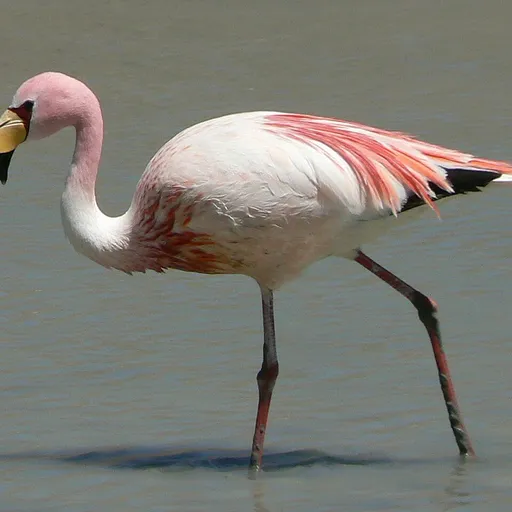
James's Flamingo
Phoenicoparrus jamesi
Near Threatened
Overview
James's flamingo, also known as the puna flamingo, is a high-altitude species of flamingo found in the Andean plateaus of Peru, Chile, Bolivia, and northwest Argentina. It is the smallest of the South American flamingos and is classed as Near Threatened by the IUCN.
Identification
- Size: Approximately 90–92 cm in length and 2 kg in weight, smaller than the Andean flamingo.
- Plumage: Very pale pink feathers with bright carmine streaks around the neck and on the back, showing small amounts of black flight feathers when perched.
- Bill: Bright yellow with a distinctive black tip.
- Legs: Long, thin, and brick red in colour, with the knee located at the top of the leg rather than being externally visible.
- Eyes: Yellow in adults with bright red skin surrounding the eye.
Habitat
This species inhabits the high-altitude Andean plateaus across Peru, Chile, Bolivia, and northwest Argentina, typically breeding in colonies that may share nesting areas with the Chilean and Andean flamingos.
Diet
James's flamingos are specialist filter feeders that consume diatoms and other microscopic algae, using the finest filter-feeding apparatus of all flamingo species. They feed by walking into shallow water and positioning the head upright to allow the bill to filter organisms, often kicking up algae with their webbed feet, and possess salt glands to manage the salt content in their Andean lake habitats.
Did you know?
The species was believed to be extinct until a population was rediscovered in a remote area in 1956.
Sources
- Wikipedia · CC BY-SA 4.0
- Wikidata · CC0 1.0