
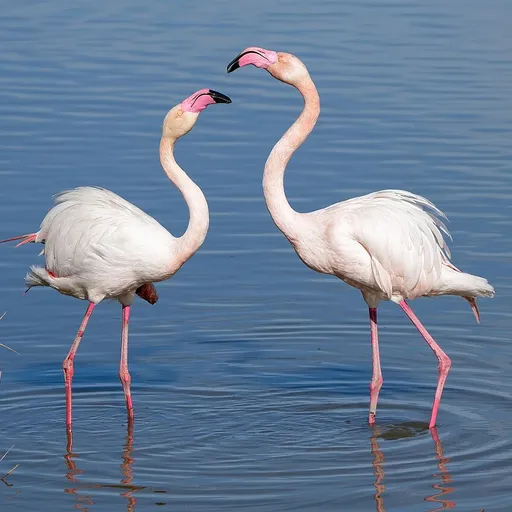
Greater Flamingo
Phoenicopterus roseus
Least Concern
Listen
XC797505 · Grégoire Chauvot · Arrondissement d'Arles (near Arles), Bouches-du-Rhone, Provence-Alpes-Côte d'Azur, France · CC0 1.0
Overview
The greater flamingo, Phoenicopterus roseus, is the largest and most widespread species in the flamingo family. It is common across the Old World, including Northern and Sub-Saharan Africa, parts of Asia, the Middle East, and Southern Europe.
Identification
- A large bird standing 110–150 cm tall, with pinkish-white plumage.
- Black primary and secondary flight feathers contrast with red wing coverts.
- Features a pink bill with a restricted black tip and entirely pink legs.
- Produces a goose-like honking call.
Habitat
Found in mudflats and shallow coastal lagoons with salt water across a wide range including Northern Africa, Sub-Saharan Africa, Southern Asia, Western Asia, and Southern Europe. The most northern breeding populations are located at the Korgalzhyn Nature Reserve in central Kazakhstan.
Diet
Feeds by stirring up mud with its feet and filtering water through its bill to extract small shrimp, brine shrimp, other crustaceans, seeds, algae, microscopic organisms, insect larvae, and molluscs. The bill's upper jaw is movable, allowing for this specific feeding method.
Did you know?
During the breeding season, these birds increase the frequency of spreading uropygial secretions over their feathers to enhance their colour, a cosmetic behaviour described as applying "make-up".
Sources
- Wikipedia · CC BY-SA 4.0
- Wikidata · CC0 1.0