
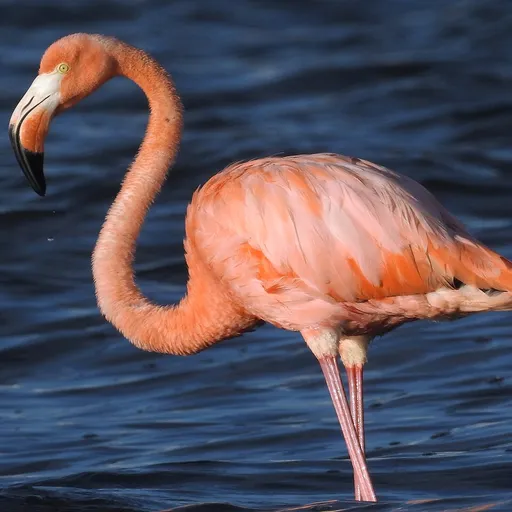
American Flamingo
Phoenicopterus ruber
Least Concern
Listen
XC737280 · Justin Watts · Celestun, Yucatan, Mexico · CC BY-SA 4.0
Overview
The American flamingo (Phoenicopterus ruber) is a large wading bird native to the West Indies, northern South America, and the Yucatán Peninsula, and is the only flamingo species that naturally inhabits North America. It is closely related to the greater flamingo but is distinguished by its reddish-pink plumage, which differentiates it from the much paler greater flamingo.
Identification
- A large wading bird with reddish-pink plumage, measuring 120 to 145 cm tall, with males averaging 2.8 kg and females 2.2 kg.
- The bill is pink and white with an extensive black tip, while the legs are entirely pink.
- Wing coverts are red, contrasting with black primary and secondary flight feathers.
- The call is described as a goose-like honking.
Habitat
The species breeds in saline lagoons, mudflats, and shallow, brackish coastal or inland lakes across the West Indies, northern South America, and the Yucatán Peninsula. It is also present in the Galápagos Islands, where the population is genetically distinct and significantly smaller than its Caribbean counterparts, and is an uncommon visitor to parts of the eastern United States following hurricanes.
Diet
The diet consists of small crustaceans, molluscs, worms, nematodes, insects and their larvae, small fish, widgeon grass, seeds, algae, diatoms, and decaying leaves. Flamingos forage by submerging their heads in water, using a specialized beak with marginal and inner/outer lamellae to filter out food of different sizes, often stirring up the bottom of the water bed with their webbed feet to bring food to the surface.
Did you know?
American flamingos have a life expectancy of 40 years, which is among the longest in the bird kingdom. They are also known to consume mud to obtain nutrients from the microorganisms and bacteria it contains.
Sources
- Wikipedia · CC BY-SA 4.0
- Wikidata · CC0 1.0