
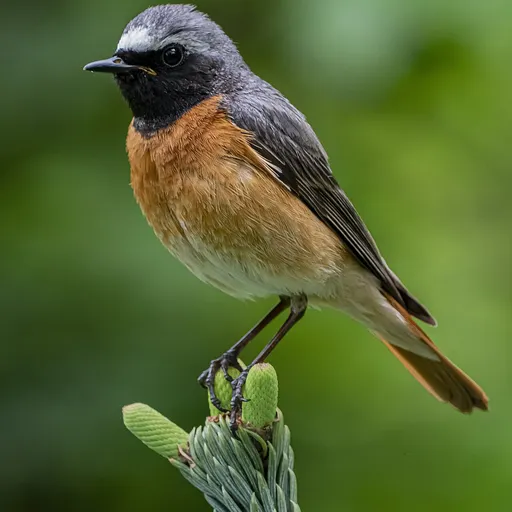
Common Redstart
Phoenicurus phoenicurus
Least Concern
Listen
XC990430 · Philippe_Grange · Arrondissement de Marseille (near Marseille), Bouches-du-Rhône, Provence-Alpes-Côte d'Azur, France · CC0 1.0
Overview
The common redstart is a small passerine bird in the Old World flycatcher family, known for its distinctive orange-red tail. It is classified as Least Concern on the IUCN Red List.
Identification
- 13–14.5 cm long with a chat-like behaviour and general carriage similar to the European Robin.
- Males have a slate-grey head and upperparts with an orange-chestnut rump, tail, flanks, and underwing coverts, while females are grey-brown above and buff-white below.
- The orange-red tail, often quivered, is a key feature, with the central feathers being dark brown and the others bright orange-red in males.
- Contact calls include a rising, slightly dissyllabic 'huid' in Central Europe, or a monosyllabic 'heed' in southern Italy and parts of the P. p. samamisicus range.
Habitat
Common Redstarts prefer open mature birch, oak, or conifer woodland with high horizontal visibility and low understorey, as well as orchards, villages, parks, and old gardens. In Britain, they are primarily found in upland areas less affected by agricultural intensification, while in Ireland, they are very rare and localised mainly to County Wicklow. They breed across Europe and western Asia, wintering in central Africa and Arabia.
Diet
The common redstart forages like a flycatcher, making aerial sallies after passing insects, with most of its food consisting of winged insects.
Did you know?
Surprisingly, the presence of a cuckoo chick in the nest may be beneficial for redstart nestlings, as the large cuckoo chick can help with thermoregulation and improve food provision for the mixed brood.
Sources
- Wikipedia · CC BY-SA 4.0
- Wikidata · CC0 1.0