
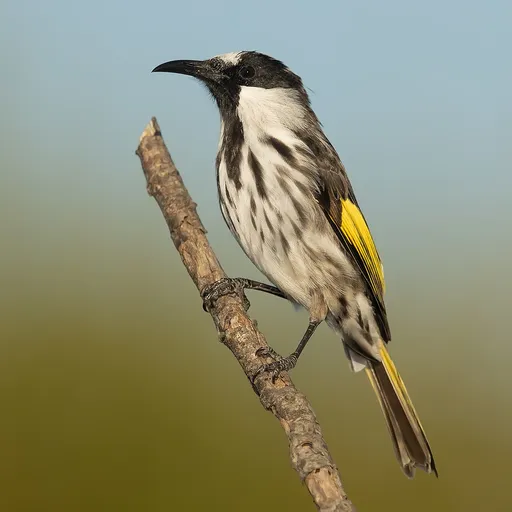
White-cheeked Honeyeater
Phylidonyris niger
Least Concern
Overview
The white-cheeked honeyeater (Phylidonyris niger) is a medium-sized black and white honeyeater endemic to eastern and south-western Australia. Classified as least concern on the IUCN Red List, it is a gregarious and active species found in both temperate and subtropical zones.
Identification
- Mainly black head with a large, conspicuous white cheek-patch and a long, tapering white brow-line.
- Plumage: Features bright-yellow tail and wing panels; juveniles appear dusky or dull brownish with yellow gape and brow.
- Bill: Long, sturdy, and curves downwards.
- Vocalisations: Distinctive yapping call ('chwikup, chwikup'), a melodious 'chippy-choo', and a high, lilting 'twee-ee-twee-ee' during display.
Habitat
Inhabits moist heathlands, paperbark swamps, wetlands, and forests or woodlands with a heath understory. The species is not afraid of humans and adapts easily to settlement activity, frequently found in parks, gardens, and flowering street trees. Its range covers the east coast from Queensland to Jervis Bay and the south-western corner of Western Australia.
Diet
Feeds mainly on nectar from flowers such as Banksia, eucalypt, Grevillea, bottlebrush, and heath. They also glean insects from bark or sally and hover to catch them in the air. Foraging is typically done busily and noisily in small groups.
Did you know?
Although the white-cheeked honeyeater and the New Holland honeyeater are very similar in appearance, they do not compete much for resources because they choose different perching sites and have different nesting seasons. Males are aggressive towards other birds during the breeding season but will not attack familiar individuals such as their mates, relatives, and resident neighbours.
Sources
- Wikipedia · CC BY-SA 4.0
- Wikidata · CC0 1.0